

2026 Senate Outlook: Trump Midterms Intensify as Democrats Gain Ground in Battle for Majority
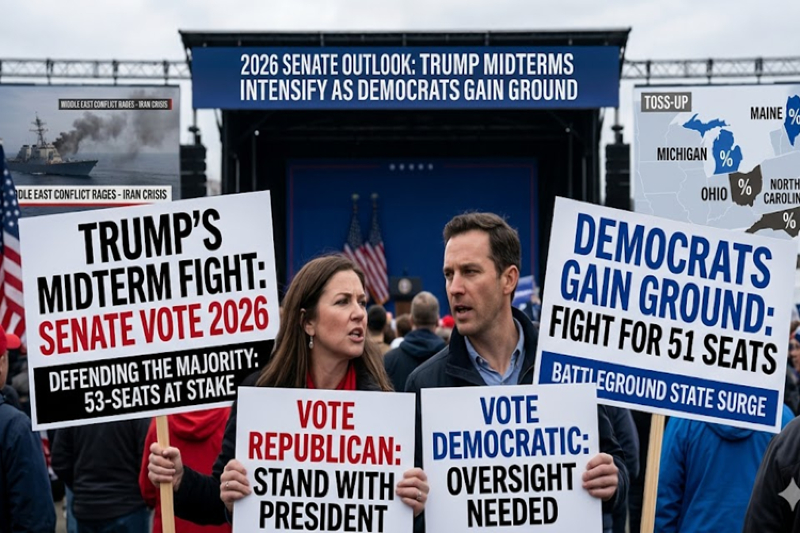
WASHINGTON/TEHRAN — As the 2026 midterm cycle reaches its peak, the political equation for control of the U.S. Senate is being dramatically reshaped by the "Trump factor."
What began as a confident Republican effort to guard a 53-seat majority has evolved into a high-stakes struggle for power.
While the President remains a dominant force in GOP politics, a combination of the expanding conflict with Iran, controversial trade tariffs, and high-profile retirements has given Democrats renewed hope of flipping the chamber.
The Midterm Referendum: Foreign Policy and Tariffs
History typically favors the party opposing the White House during midterms, and 2026 is no exception.
While core supporters favor the decisive military action, polling indicates that independent voters are increasingly concerned about a widening Middle Eastern war.
Additionally, the administration’s aggressive tariff policies have created a rift in the Midwest. In states like Iowa and Michigan, where agriculture and manufacturing are the economic backbones, the cost of trade barriers is being weaponized by Democratic challengers. Recent data shows a national preference for Democratic congressional oversight, turning once-safe GOP seats into "toss-ups."
The New England Battleground: Maine’s Unprecedented Shift
In Maine, veteran GOP Senator Susan Collins is facing the most critical challenge of her five-term career.
The race has been upended by Graham Platner, a progressive oyster farmer and veteran who has stunned the establishment. Recent polling shows Platner holding a commanding 33-point lead in the Democratic primary over Governor Janet Mills.
Even more alarming for the GOP, Platner currently leads Collins 48% to 39% in general election matchups.
The Great Lakes and the Midwest: Michigan and Ohio
Control of the Senate may well be decided in the Rust Belt:
Michigan: With Senator Gary Peters retiring, the race to replace him is a true toss-up.
Haley Stevens currently leads a crowded Democratic primary in fundraising, but the race is deeply defined by the state’s large Arab-American community’s response to the war in the Middle East. On the GOP side, Mike Rogers—the 2024 nominee who narrowly lost his last bid—has returned with a massive $45 million ad war chest provided by the Senate Leadership Fund. Ohio: Former Senator Sherrod Brown is attempting a historic comeback against the appointed Republican incumbent, John Husted.
Despite Ohio’s rightward shift, Brown’s "working-class populist" brand remains potent. Recent surveys show a dead-heat, with Brown holding a razor-thin two-point edge in some polls. This race is currently the GOP’s largest defensive investment, with a staggering $79 million reserved for advertising.
The Southern Front: Georgia and North Carolina
In the South, the "Trump factor" is a double-edged sword:
Georgia: Senator Jon Ossoff was initially viewed as the cycle's most vulnerable Democrat.
However, a messy Republican primary has given him a "Leaning Democrat" status. The GOP field is split between Buddy Carter, Mike Collins, and football coach Derek Dooley, who holds the endorsement of Governor Brian Kemp. Without a unified challenger, Ossoff has used his massive fundraising advantage to build a firewall in the Atlanta suburbs. North Carolina: The retirement of Thom Tillis has created a "clash of the titans."
Democrats have fielded their top recruit, former Governor Roy Cooper, who is running on a platform of reversing tariffs. He faces Michael Whatley, the former RNC chair and a staunch ally of the President. With $71 million already committed to the race, North Carolina is a "Toss-Up" that could determine the Senate majority on election night.
Conclusion: A Narrow Path to 51
From the populist surge in Nebraska to the bitter GOP runoff in Texas between John Cornyn and Ken Paxton, the 2026 midterms are a direct referendum on the President's vision for the country. For Democrats, the path to 51 seats requires winning nearly all the "Toss-Up" races in the Rust Belt while successfully defending Georgia. For Republicans, the challenge is holding onto moderate-leaning seats in Maine and North Carolina while the national mood shifts under the weight of international conflict.