
Hezbollah Defies Diplomacy: Qassem Rejects Washington Peace Talks as "Futile Ploy"
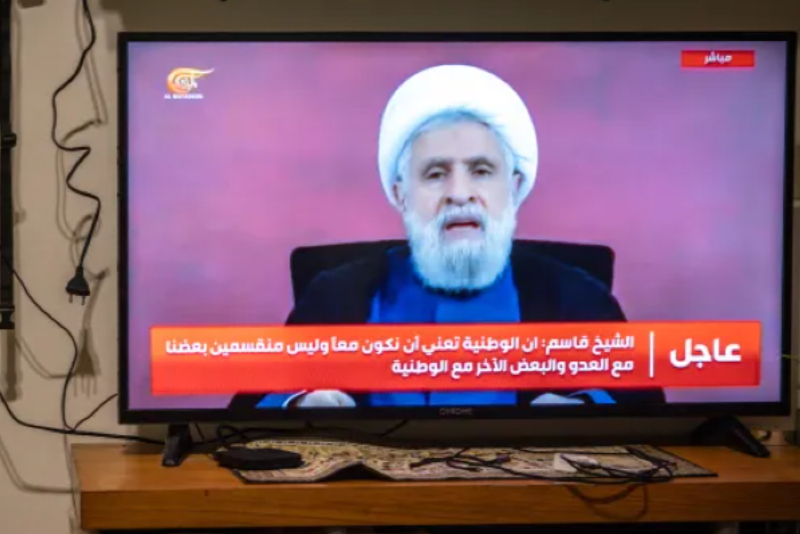
BEIRUT, Lebanon — In a high-stakes televised address on Monday, Hezbollah leader Naim Qassem officially rejected upcoming diplomatic meetings between the Lebanese government and Israel, calling for a "historic and heroic" boycott of the negotiations.
The talks, facilitated by the United States and scheduled for Tuesday in Washington, D.C., were intended to bring the Lebanese and Israeli ambassadors together for direct negotiations. However, Qassem dismissed the initiative as a strategic trap designed to force the group to disarm while Israeli military operations continue to escalate.
The Standoff Over Disarmament
The primary point of contention lies in the stated goals of the negotiations. Israeli Prime Minister Benjamin Netanyahu has made the dismantling of Hezbollah’s arsenal a non-negotiable priority for any lasting peace agreement.
"Israel clearly states that the goal of these negotiations is to disarm Hezbollah," Qassem said during his speech. "How can you go to negotiations whose objective is already clear?"
He characterized the planned talks as a "free concession" to the U.S. and Israel, arguing that the Lebanese government was "backstabbing" the resistance by engaging with a state that continues to occupy southern territory and bomb civilian areas.
A Cycle of Retaliation
The conflict has spiraled since early March, following a massive rocket barrage from Hezbollah in response to the U.S.-Israeli assassination of Iran’s Supreme Leader, Ayatollah Ali Khamenei. Since the start of the ground invasion and intensified aerial campaign:
Casualties: At least 2,055 people have been killed in Lebanon, including 165 children.
Health Crisis: 87 medical workers have died, and over 6,500 people are wounded.
Displacement: An estimated 1.2 million residents have been forced to flee their homes.
While Lebanese authorities, led by Prime Minister Nawaf Salam, argue that a diplomatic presence is necessary to secure a ceasefire, Hezbollah maintains that only the "battlefield" can resolve the crisis.
Domestic Pressure and Military Escalation
The rejection of the talks comes amid growing internal unrest. Over the weekend, hundreds of protesters in Beirut voiced their opposition to the Washington meeting, accusing the government of betrayal while Israeli forces expand their ground presence.
On the ground, the Israeli military announced on Monday that it has completely encircled the strategic southern town of Bint Jbeil. Despite the encirclement, Qassem insisted that northern Israeli settlements would remain unsafe and that Hezbollah forces would neither "rest nor surrender."
Timeline of the Scheduled Talks
Thursday, April 9: Israeli Prime Minister Benjamin Netanyahu announced that his cabinet had authorized opening direct contacts with the Lebanese government.
Friday, April 10: U.S. officials confirmed that the State Department would host the meeting this week.
Sunday, April 12: A preliminary virtual meeting was reportedly held between key representatives to set the groundwork.
Monday, April 13: Hezbollah leader Naim Qassem delivered a televised address calling for the "historic and heroic" cancellation of the meeting, labeling the talks a trap.
Tuesday, April 14 (Today): The ambassadors are set to meet to discuss a potential long-term peace agreement and the disarmament of Hezbollah.
Current Standoff
The talks are proceeding under a cloud of deep disagreement. While Lebanese President Joseph Aoun and Prime Minister Nawaf Salam have pushed for these talks as a way to secure a stable ceasefire, Hezbollah has rejected them as a "free concession" to Israel. Meanwhile, the Israeli military has continued its operations in southern Lebanon, stating it will not discuss a ceasefire with Hezbollah until its disarmament is achieved.