
Scientists Witness Historic "Civil War" Among Ugandan Chimpanzees
KIBALE NATIONAL PARK, Uganda — A groundbreaking study published in the journal Science has revealed a rare and violent "civil war" within the world’s largest known community of wild chimpanzees, marking the first time such internal lethal conflict has been documented in non-human animals.
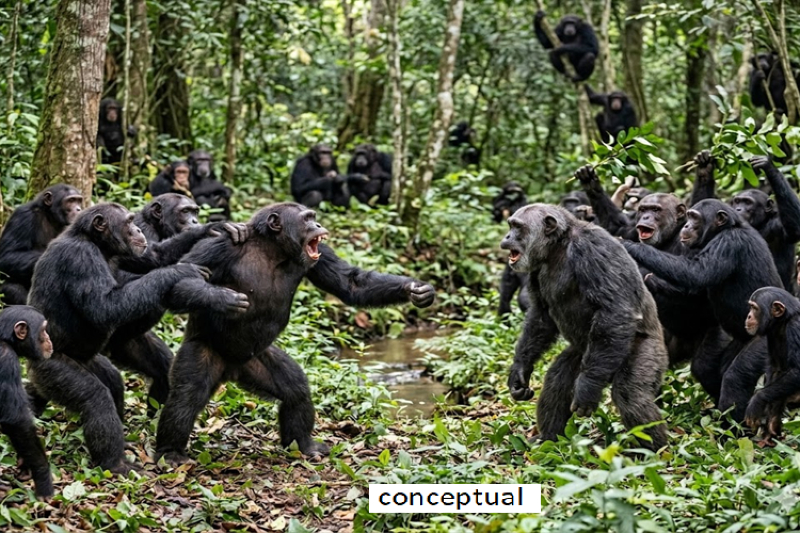
For nearly 30 years, researchers tracked the Ngogo chimpanzees in Uganda’s Kibale National Park. The group, numbering roughly 200 individuals, lived as a cohesive society for decades. however, new data shows the community fractured into two warring factions, resulting in a years-long campaign of targeted violence.
A Society Divided
The rift began to manifest in 2015. Scientists noticed that the "Western" and "Central" subgroups, which previously coexisted peacefully, began to avoid one another. By 2018, the split became permanent, with the two groups separating geographically and reproductively.
According to genetic modeling, such a "permanent fission" in a chimpanzee colony is an exceptionally rare event, estimated to occur only once every 500 years.
The Toll of the Conflict
The transition from neighbors to enemies turned deadly over the following six years. Between 2018 and 2024, researchers documented a series of brutal attacks:
7 adult males from the Central cluster were killed by Western attackers.
17 infants were also victims of the lethal raids.
"What’s especially striking is that the chimpanzees are killing former group members," explained Aaron Sandel, the study’s lead author and an associate professor of anthropology at the University of Texas at Austin. "New group identities are overriding cooperative relationships that had existed for years."
Rethinking the Roots of Human Conflict
The discovery has significant implications for how we understand human tribalism. While human wars are often attributed to abstract concepts like religion, language, or political ideology, the Ngogo chimpanzees reached a state of lethal polarization without any of these cultural markers.
Researchers suggest several "basic" catalysts for the split:
Overpopulation: The group had grown unusually large.
Resource Scarcity: Intense competition for food and mates.
Leadership Voids: Changes in the male hierarchy and the sudden death of six key individuals just before the initial 2015 avoidance.
The findings suggest that the drive to form "us vs. them" identities and engage in group-based hostility may be a fundamental biological trait, rather than one solely driven by human culture.