
Royal Rift Inside the Palace: Andrew–Charles Relationship Tests Family Duty and Crown Authority
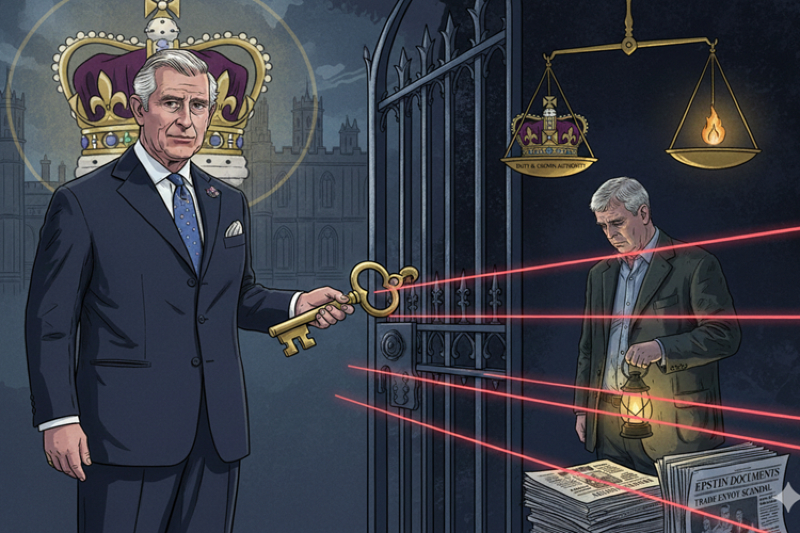
The relationship between King Charles III and his younger brother Prince Andrew has moved beyond family tension into a highly sensitive constitutional and public scrutiny issue, blending personal loyalty with institutional responsibility.
The unfolding story is not simply about a legal investigation involving Andrew; it also reflects a deeper narrative of two brothers shaped by contrasting personalities and expectations within the royal household. While one was destined for the throne, the other became embroiled in controversy that continues to shadow the monarchy.
King Charles has publicly stated that law enforcement authorities must be allowed to conduct their inquiry without interference. Royal statements have emphasized that no individual, regardless of status or royal connection, should be considered beyond the reach of justice.
At the same time, palace insiders suggest the monarch faces the difficult task of balancing institutional integrity with personal responsibility toward his brother.
The monarch’s response to Andrew’s situation has combined institutional distance with personal concern. Reports indicate that Andrew was removed from public royal duties and faced financial and residential restrictions following renewed controversy surrounding his associations, including links discussed in documents related to financier Jeffrey Epstein.
Despite the disciplinary measures, sources close to the palace say the King remains concerned about Andrew’s welfare. Although Andrew was compelled to leave his previous residence, arrangements were reportedly made to provide alternative private accommodation funded privately by the monarch rather than public money.
The royal household has attempted to separate the roles of working and non-working members of the monarchy. Officials say that active royal duties are being carried out by senior members supporting national and constitutional responsibilities, while Andrew’s legal and personal matters are handled independently.
Tensions between the brothers are often described as a modern reflection of the long-standing royal dilemma between duty and family. Observers note that Charles, once viewed as a reserved and introspective heir, has demonstrated unexpected decisiveness in managing the controversy surrounding his sibling since ascending the throne.
Andrew’s past role as a trade envoy, which ended in 2011 amid criticism over his personal associations, has also drawn renewed attention in public discussions. Critics have questioned the judgment surrounding his appointment, arguing that the diplomatic position ultimately damaged the royal family’s international reputation.
Public and media focus has also intensified following the release of documents connected to Epstein, which reignited debate over Andrew’s historical social contacts. While Andrew has consistently denied any wrongdoing, the ongoing investigation has kept the royal family under pressure.
Royal analysts say the current situation illustrates a unique challenge for the British monarchy: maintaining the appearance of unity while enforcing institutional discipline.
Unlike political institutions, the royal family cannot simply remove a member from its structure, making the management of internal scandal particularly complex.
For now, the palace appears determined to prioritize constitutional responsibility over personal sentiment, signaling that the monarchy’s public legitimacy will remain the guiding principle as the investigation continues.
Reported Signs of Royal Tension
There is no publicly confirmed statement from either King Charles III or Prince Andrew explicitly declaring a “royal rift.” However, several reported incidents are widely interpreted by media as evidence of strained relations between the brothers:
Removal of Royal Duties and Titles – Andrew was stripped of military affiliations and public royal responsibilities following controversies linked to his association with Jeffrey Epstein. This institutional distancing is often cited as a sign of palace disapproval.
Financial and Housing Pressure Reports – Multiple media reports suggested that King Charles reduced Andrew’s royal funding and pushed for him to leave Royal Lodge, which was described as part of efforts to limit his royal privileges.
Public Statement Emphasizing Rule of Law – After Andrew’s arrest under investigation, the King stated that authorities must be allowed to conduct their inquiry without interference, a remark interpreted by observers as formal separation between family loyalty and constitutional duty.
End of Trade Envoy Role (2011) – Andrew’s removal from his international trade ambassador position amid diplomatic criticism is often viewed as an earlier institutional signal of declining royal confidence.
Independent Living Arrangement Discussions – Reports that Andrew was provided private accommodation funded personally by the monarch rather than from public funds have been interpreted as a compromise between family responsibility and institutional separation.
These points are based on reported events and media interpretations rather than an official declaration of a personal feud.