

China Expands Nuclear Submarine Production, Raising Strategic Questions for Washington
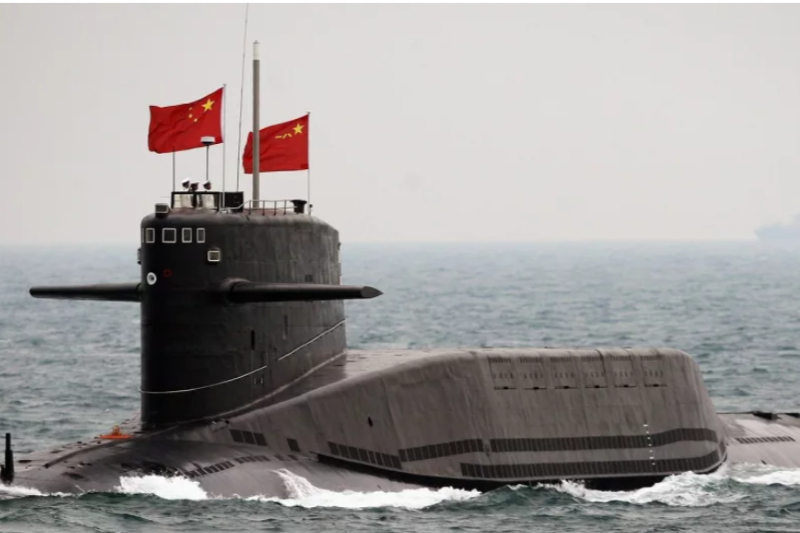
China has sharply accelerated construction of nuclear-powered submarines over the past five years, launching more boats than the United States during that period and signaling a shift in the balance of undersea industrial capacity, according to a new report by the International Institute for Strategic Studies (IISS).
The report suggests that while the U.S. Navy retains a decisive operational edge, Beijing’s faster production tempo could narrow Washington’s long-standing advantage beneath the seas if current trends continue.
Production Pace Shifts in Beijing’s Favor
Between 2021 and 2025, China launched 10 nuclear-powered submarines, compared with seven launched by the United States, according to IISS analysis based on satellite imagery of Chinese shipyards.
In total displacement, China’s launches amounted to approximately 79,000 tons, exceeding the U.S. figure of 55,500 tons during the same timeframe.
That marks a significant reversal from 2016 to 2020, when China added just three nuclear submarines while the U.S. launched seven.
China does not publicly disclose detailed fleet figures, making independent analysis crucial to tracking developments.
Expansion at Huludao Shipyard
To support its growing nuclear fleet, Beijing has expanded facilities at the Huludao shipyard operated by Bohai Shipbuilding Heavy Industry Co., according to the IISS report titled “Boomtime at Bohai.” The yard is considered central to China’s nuclear submarine construction program.
The report highlights the launch of two Type 094 ballistic missile submarines (SSBNs), which form part of China’s sea-based nuclear deterrent. These submarines are capable of carrying nuclear-armed ballistic missiles, strengthening the maritime leg of Beijing’s nuclear triad alongside land-based intercontinental ballistic missiles and strategic bombers.
Production of the next-generation Type 096 SSBN is expected to begin later this decade, potentially entering service in the late 2020s or early 2030s.
In addition to ballistic-missile submarines, the IISS estimates that China has launched at least six nuclear-powered guided-missile submarines (SSGNs) over the past five years. These vessels are equipped with vertical launch systems capable of deploying advanced anti-ship and land-attack missiles.
Fleet Comparison: U.S. Maintains Operational Edge
Despite China’s faster launch rate, the United States continues to hold a substantial advantage in total operational submarines.
According to the IISS Military Balance 2025 assessment:
China operates 12 active nuclear-powered submarines — six ballistic-missile boats and six attack or guided-missile boats.
United States operates 65 submarines in total, including 14 ballistic-missile submarines.
China also fields 46 conventionally powered submarines, bolstering its regional presence.
Importantly, launch figures do not automatically translate into fully operational vessels. Sea trials, crew training, and systems integration can take years before submarines enter active service.
U.S. Industrial Challenges
While China expands output, Washington faces production bottlenecks.
A recent report from the Congressional Research Service noted that the U.S. Navy has fallen short of its goal to produce two Virginia-class attack submarines annually. Since 2022, U.S. shipyards have delivered between 1.1 and 1.2 boats per year.
At the same time, the Navy is building the next-generation Columbia-class ballistic-missile submarines. However, the lead vessel, USS District of Columbia, is now expected to be delivered in 2028 — at least a year later than originally projected.
Navy leadership has acknowledged broader shipbuilding challenges, including schedule delays and cost overruns across multiple programs.
The “Valley” in U.S. Submarine Numbers
According to congressional analysis, the U.S. attack submarine fleet is projected to dip to 47 boats by 2030 as aging Los Angeles-class submarines are retired. A recovery to around 50 submarines may not occur until 2032 — assuming construction targets are met.
Additionally, planned transfers of Virginia-class submarines to Australia under the AUKUS security partnership could temporarily constrain U.S. fleet growth.
Defense analysts warn that this projected shortfall — sometimes referred to as the “submarine valley” — could create operational strain and test conventional deterrence in the Indo-Pacific.
Quality vs. Quantity Debate
Despite the production surge, the IISS report notes that Chinese submarine technology likely remains behind that of the United States and several European navies in key areas such as acoustic quieting.
Stealth remains one of the most critical advantages in submarine warfare, and U.S. boats are widely considered among the quietest in the world.
Still, analysts caution that in prolonged maritime competition, numerical strength can play a decisive role — particularly in contested regional waters.
Strategic Outlook
China’s submarine expansion reflects a broader modernization effort that has already made its navy the world’s largest by overall ship count. While the United States maintains a clear operational lead, sustained Chinese industrial momentum could reshape undersea dynamics over the next decade.
For Washington, the challenge is less about immediate parity and more about long-term capacity — balancing modernization, alliance commitments, and industrial reform while maintaining its strategic advantage beneath the waves.