
Iran Displays Billboard Showing Israeli Targets as Netanyahu Prepares White House Visit
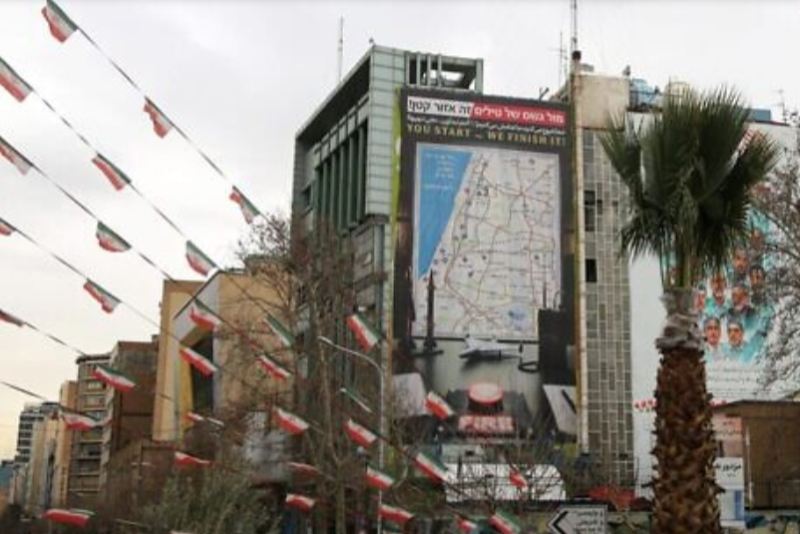
February 10, 2026: Iranian authorities have erected a large billboard in central Tehran displaying a map of what it describes as potential targets in Israel’s Tel Aviv area, amid heightened regional tensions and renewed diplomatic activity involving the United States, Israel, and Iran.
The billboard, installed over the weekend at Palestine Square—a location frequently used for political messaging—features a map alongside the slogan, “You start, we finish!”. Images of the display circulated widely on social media and international news platforms on Monday.
The move comes as uncertainty continues over whether the United States may take military action against Iran, while Israeli Prime Minister Benjamin Netanyahu is expected to visit Washington later this week for talks with U.S. President Donald Trump.
According to a statement from Netanyahu’s office issued on Saturday, the Israeli leader plans to discuss ongoing negotiations between the United States and Iran.
The statement said Netanyahu believes any agreement should include restrictions on Iran’s ballistic missile program and an end to Tehran’s support for regional allied groups.
The billboard appeared as diplomatic efforts intensified behind the scenes. On Friday, U.S. Middle East adviser Jared Kushner and special envoy Steve Witkoff held direct talks with Iranian Foreign Minister Abbas Araqchi in Oman.
Araqchi later described the discussions as a “good start,” while emphasizing that Iran is only willing to negotiate over its nuclear program, not its missile capabilities.
President Trump also commented on the talks, telling reporters that discussions with Iran had been “very good,” suggesting Tehran may be open to greater concessions than in previous negotiations. However, he cautioned that failure to reach an agreement would carry serious consequences.
At the same time, the United States has increased its military presence in the region. Kushner and Witkoff visited a U.S. naval aircraft carrier that was recently deployed as part of what Trump has described as a broader military buildup designed to give Washington options if diplomacy fails.
Iran has repeatedly warned that it would consider both U.S. and Israeli interests as legitimate targets if the United States launches strikes aimed at limiting Iran’s nuclear activities. Such warnings follow U.S. airstrikes on Iranian facilities less than a year ago, during a period of direct conflict between Iran and Israel.
Netanyahu’s upcoming visit to the White House—his fourth since Trump returned to office—comes at a critical moment. During a previous meeting last April, Trump publicly confirmed for the first time that Washington had opened direct talks with Tehran. Two months later, the United States joined Israeli military operations against Iran.
As diplomatic negotiations continue, the display in Tehran underscores the tense atmosphere surrounding the talks and highlights the broader regional stakes as leaders weigh the balance between diplomacy and confrontation.