
Zarif Proposes "Victory" Blueprint as Trump Escalates Threats Against Iranian Infrastructure
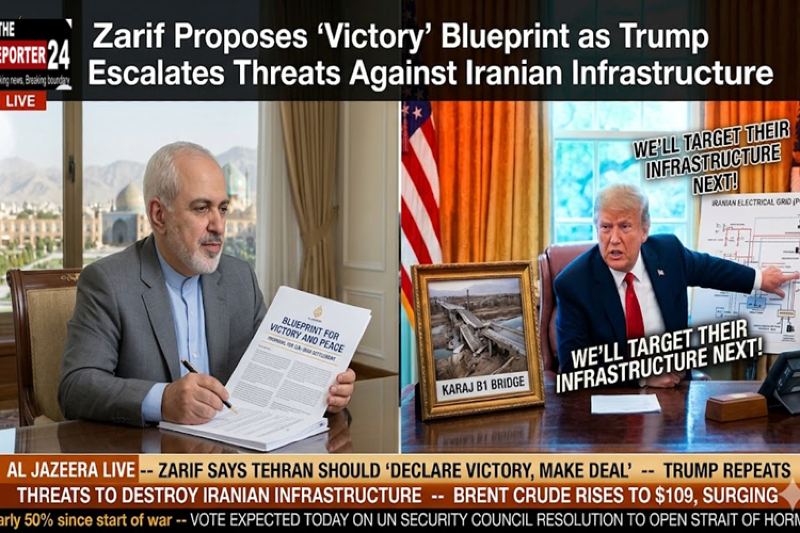
TEHRAN/WASHINGTON – In a high-stakes diplomatic gambit, former Iranian Foreign Minister Javad Zarif has urged Tehran to "declare victory" and pursue a settlement to end the devastating month-long war with the United States and Israel.
The proposal, published in Foreign Affairs on Friday, comes as President Donald Trump warned that the U.S. military has "not even started" its destruction of Iran’s remaining infrastructure.
A Blueprint for Peace
Zarif, the architect of the 2015 nuclear deal, outlined a strategic path for Iran to exit the conflict while maintaining its national interests. His proposal suggests a "grand bargain" that addresses long-standing points of contention:
Nuclear Limits for Sanctions Relief: Iran would offer strict limits on its nuclear program and reopen the Strait of Hormuz in exchange for a total lifting of international sanctions.
Mutual Non-Aggression: A formal pact where both Washington and Tehran pledge to refrain from future strikes.
Economic Cooperation: Opening doors for U.S.-Iran economic interactions, framed as a "win-win" for both populations.
Writing on X (formerly Twitter), Zarif admitted he was "outraged" by Trump’s rhetoric but emphasized that "war must end on terms consistent with Iran’s national interests."
Trump’s "Stone Age" Warning
The diplomatic overture stands in stark contrast to the escalating military rhetoric from the White House. Following a U.S. strike that demolished the B1 Bridge in Karaj—reportedly killing eight civilians—President Trump took to social media to signal a shift toward targeting civilian-critical assets.
"Our Military... hasn't even started destroying what's left in Iran," Trump posted.
"Bridges next, then Electric Power Plants! New Regime leadership knows what has to be done, and has to be done, FAST!"
Defense Secretary Pete Hegseth echoed this sentiment, suggesting the U.S. could bomb Iran "back to the stone ages" if it does not capitulate by April 6.
Global Economic and Humanitarian Fallout
The conflict, which began on February 28, has sent shockwaves through global markets and triggered a brewing humanitarian crisis:
Oil Prices: Brent crude surged 8% on Friday, topping $109 a barrel.
Prices have climbed nearly 50% since the war's onset. Strait of Hormuz: While intelligence firm Windward reports a slight uptick in transits (16 vessels on Wednesday), traffic remains a fraction of the 130-ship daily average seen before the blockade.
Medical Infrastructure: Iranians have expressed outrage over the strike on the Pasteur Institute in Tehran.
Officials claim the facility, vital for vaccine production, is a civilian target, and its destruction constitutes a war crime.
Regional Escalation
As the UN Security Council prepares to vote on a resolution authorizing "defensive means" to reopen the Strait of Hormuz, the violence continues to spill over:
Kuwait: A drone strike hit the Al Ahmadi oil refinery, causing fires but no reported casualties.
Saudi Arabia & UAE: Both nations reported intercepting fresh waves of missiles and drones over the past 24 hours.
Pakistan: A country previously holding an LNG surplus is now facing a "looming shortage" as supply lines from Qatar and the UAE are disrupted.
While Zarif’s proposal offers a theoretical off-ramp, the gulf between Tehran's "victory" narrative and Washington's "maximum pressure" military campaign remains vast, leaving the region on a knife-edge.