

Part 2 – Shadows in the Glass
By Munshi Firoz Al Mamun
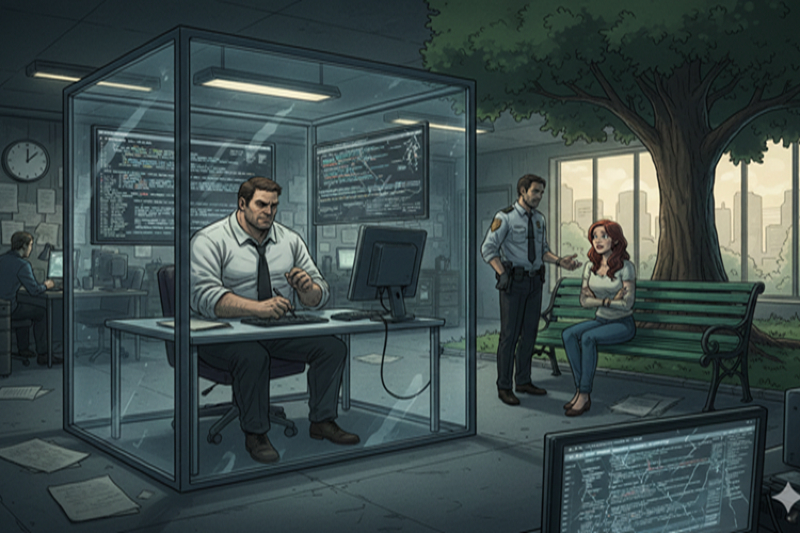
Mankin Devil had climbed another rung in the corporate ladder. From a shadow in the newsroom to Chief Reporter of the Daily, he now commanded the office—not through respect, but through intimidation and self-preservation. His office, a sterile enclosure of glass and steel, served as both fortress and observation post. From behind the transparent walls, he peered like a wary hawk, tracking the steps of subordinate reporters. Whenever anyone approached, he would lift his pen, feign deep concentration on his screen, and sink into the illusion of work, leaving questions unanswered, curiosity unsatisfied. Distance was his armor; invisibility, his ally.
Yet outside the newsroom, Mankin sought another conquest—a high-profile girl whose laughter seemed brighter than fluorescent lights. Linda.
The park was their chosen stage, a veneer of romance stretched over unease. One afternoon, while sitting on a sun-warmed bench, Linda asked casually, “So, tell me about your journalism experience.”
Mankin stiffened. He avoided her gaze. “Not a suitable topic for the park,” he muttered, forcing a light smile. “There may be offenders around. I prefer to keep my identity hidden… just in case.”
Romance, however, was a language he had never mastered. Words faltered. Gestures felt rehearsed. That day, the park did not yield to desire—it yielded discomfort.
A few days later, Linda returned to the park with him, hoping for lessons in physics to help with her upcoming exams. The request, innocent as it seemed, triggered panic. Desperate to escape, Mankin glanced at another girl passing by, letting curiosity—or envy—draw Linda’s attention elsewhere. A spark of jealousy lit the afternoon.
But the act backfired. The other girl, feeling slighted and threatened, reported the incident to the police. Mankin’s brief freedom evaporated. Arrested, questioned, humiliated, he spent three restless days in custody. Yet like a seasoned manipulator, he spun the tale for the newsroom: “I was out of town on emergency matters,” he claimed, returning to his office with his power intact, untarnished in the eyes of management.
From afar, he had noticed the hero’s transformation. Hansen—the once-crushed journalist—was thriving in the realm of technology, mastering PHP, Laravel, and digital innovation. Curiosity and envy collided. One evening, Mankin paid a courtesy call at Hansen’s home, an almost ceremonial visit masking ulterior intent. As he left, he pocketed a class note on PHP lessons, a silent acknowledgment of the hero’s new dominion.
Back at the Daily, ambition stirred in Mankin’s mind. He imagined himself in command of the online portal, the kingdom he had always coveted. One night, alone at his desk, he accessed the C-panel and clicked on code he barely understood.
The results were immediate and catastrophic. The portal’s design collapsed into chaos. Headlines floated without alignment, images overlapped, and navigation crumbled. The management erupted in fury. Investigations commenced.
Desperate, Mankin applied for a seven-day leave, citing medical reasons, all the while plotting the next move. Knowing the hero held the knowledge he lacked, he returned to Hansen’s home, imploring help. But Hansen, now untethered from the chains of office, shook his head.
“I left the Daily two years ago,” Hansen said calmly. “I don’t go back there. I don’t want to.”
The office portal remained broken. Mankin’s ambition had collided with reality, and the hero, once powerless under the corporate shadow, had stepped beyond its reach.
▶ Read part 3 https://thereporter24.com/news/part-3-the-broken-code