

BNP Back in Office After Two Decades as Tarique Rahman Assumes Premiership
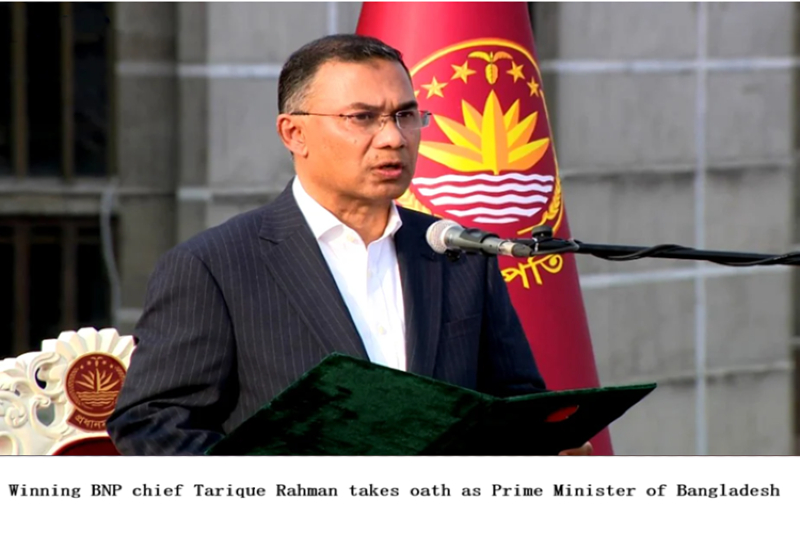
The Bangladesh Nationalist Party (BNP) has returned to power after almost 20 years, with party Chairperson Tarique Rahman sworn in as the Prime Minister following a decisive victory in the 13th parliamentary elections.
The BNP secured 209 seats in the 300-member Jatiya Sangsad, giving it a clear majority and enabling it to form the government without coalition partners. The outcome marks a major political shift in Bangladesh’s landscape.
Tarique Rahman takes over from interim government chief Muhammad Yunus, who assumed office on August 8, 2024, after the fall of the Awami League administration amid a student-led mass movement.
Oath Ceremonies at Parliament
The swearing-in events were held at the Jatiya Sangsad Bhaban in Dhaka. Newly elected Members of Parliament took their oath at 10:00am at the South Plaza of the complex. Later, at 4:00pm, the prime minister and cabinet members were formally sworn in at the same venue.
Chief Election Commissioner AMM Nasir Uddin administered the oath to the lawmakers. President Mohammed Shahabuddin conducted the swearing-in of the prime minister and his cabinet colleagues.
The ceremony drew a broad spectrum of guests, including Om Birla, Speaker of India’s Lok Sabha, along with foreign ministers from member states of the South Asian Association for Regional Cooperation (SAARC). Representatives from civil society, as well as outgoing advisers and officials of the interim administration, were also in attendance.
Election Outcome and Parliamentary Dynamics
The 13th Jatiya Sangsad elections were held on February 12, alongside a nationwide referendum. Of the 299 parliamentary seats contested, results were officially declared for 297.
With 209 seats secured, the BNP achieved an outright majority in parliament. Meanwhile, its former ally Bangladesh Jamaat-e-Islami won 68 seats and is set to take on the role of the main opposition in the new parliament.
Constitutional Reform Council Planned
Addressing the implementation of the July National Charter, Special Assistant to the Chief Adviser Ali Riaz said that the Implementation Order 2025 requires the formation of a Constitution Reform Council.
He explained that the proposed council will comprise elected Members of Parliament and will be responsible for integrating the reform proposals outlined in the charter into the constitution within 180 days of its formation.
With the transfer of authority now complete, the BNP-led administration begins its term amid expectations of political restructuring and constitutional reform, as the country enters a new phase of governance.
Below is the complete list of full ministers and state ministers sworn in as part of the new cabinet.
Full Ministers
The following leaders took oath as full ministers:
Mirza Fakhrul Islam Alamgir — Ministry of Local Government, Rural Development & Co-operatives
Amir Khasru Mahmud Chowdhury — Ministry of Finance and Ministry of Planning
Salahuddin Ahmed — Ministry of Home Affairs
Iqbal Hasan Mahmud Tuku — Ministry of Power, Energy & Mineral Resources
Hafiz Uddin Ahmed (Bir Bikram) — Ministry of Liberation War Affairs
AZM Zahid Hossain — Ministry of Women and Children Affairs and Ministry of Social Welfare
Dr Khalilur Rahman (Technocrat) — Ministry of Foreign Affairs
Abdul Awal Mintoo — Ministry of Environment, Forest and Climate Change
Kazi Shah Mofazzal Hossain Kaikobad — Ministry of Religious Affairs
Mizanur Rahman Minu — Ministry of Land
Khandaker Abdul Muktadir — Ministry of Commerce, Industries, Textile & Jute
Ariful Haque Chowdhury — Ministry of Expatriates' Welfare & Overseas Employment
Zahir Uddin Swapan — Ministry of Information and Broadcasting
Mohammad Amin ur Rashid (Technocrat) — Ministry of Agriculture, Fisheries and Livestock
Afroza Khanam Rita — Ministry of Civil Aviation and Tourism
Shahid Uddin Chowdhury Annie — Ministry of Water Resources
Md Asaduzzaman — Ministry of Law, Justice and Parliamentary Affairs
Zakaria Taher Suman — Ministry of Housing and Public Works
Dipen Dewan — Ministry of Chittagong Hill Tracts Affairs
Nitai Roy Chowdhury — Ministry of Cultural Affairs
State Ministers
The following members were sworn in as state ministers:
M Rashiduzzaman Millat — Ministry of Civil Aviation and Tourism
Anindya Islam Amit — Ministry of Power, Energy & Mineral Resources
Md Shariful Alam — Ministry of Commerce, Industries and Textiles & Jute
Shama Obaed Islam — Ministry of Foreign Affairs
Sultan Salauddin Tuku — Ministry of Agriculture, Fisheries and Livestock, and Ministry of Food
Kaiser Kamal — Ministry of Land
Farhad Hossain Azad — Ministry of Water Resources
Aminul Haque (Technocrat) — Ministry of Youth and Sports
Mir Mohammad Helal Uddin — Ministry of Chittagong Hill Tracts Affairs
Habibur Rashid — Ministry of Road Transport and Bridges, Ministry of Railways and Ministry of Shipping
Rajib Ahsan — Ministry of Road Transport and Bridges, Ministry of Railways and Ministry of Shipping
Abdul Bari — Ministry of Public Administration
Mir Shahe Alam — Ministry of Local Government, Rural Development & Co-operatives
Jonayed Abdur Rahim Saki — Ministry of Finance, Ministry of Planning and Ministry of Home Affairs
Ishraq Hossain — Ministry of Liberation War Affairs
Farzana Sharmin — Ministry of Women and Children Affairs and Ministry of Social Welfare
Sheikh Faridul Islam — Ministry of Environment, Forest and Climate Change; Religious Affairs; and Law, Justice and Parliamentary Affairs
Nurul Haque Nur — Ministry of Labour and Employment; Expatriates' Welfare and Overseas Employment
Yasser Khan Chowdhury — Ministry of Information and Broadcasting
M Iqbal Hossain — Ministry of Disaster Management and Relief
MA Muhith — Ministry of Health and Family Welfare; Posts, Telecommunications and Information Technology; and Science and Technology
Ahmed Sohel Manjur — Ministry of Housing and Public Works
Bobby Hajjaj — Ministry of Education and Ministry of Primary and Mass Education
Ali Newaz Mahmud Khaiyam — Ministry of Cultural Affairs
Shafiqur Rahman Named Opposition Leader; Syed Abdullah Mohammad Taher Deputy, Nahid Islam Chief WhipDhaka, February 17, 2026: The 13th Jatiya Sangsad has formally designated Jamaat-e-Islami Ameer Shafiqur Rahman as the Leader of the Opposition. The decision was taken at a parliamentary party meeting held on Tuesday following the oath-taking ceremony of newly elected lawmakers.
Jamaat’s Nayeb-e-Ameer Syed Abdullah Mohammad Taher has been appointed Deputy Leader of the Opposition. Meanwhile, Nahid Islam, convener of the National Citizen Party (NCP), has been chosen as the Opposition Chief Whip.
The information was confirmed by Saiful Alam Khan (Milon), a Jamaat lawmaker elected from Dhaka-12, after the meeting of the parliamentary party.
Decision by 11-Party Alliance
According to sources within the parliamentary bloc, the announcement will soon be made official through a joint press release from the 11-party alliance that contested the national election together.
Earlier in the day, Jamaat-e-Islami lawmakers took their oath as members of parliament around 12:30 pm, followed by members from the NCP. In addition to being sworn in as MPs, representatives of the 11-party electoral alliance also took oath as members of the Constitution Reform Council.
The appointments mark the formal structuring of the opposition bench in the newly formed parliament following the 13th general election.
BNP Lawmakers Refuse Oath for Constitution Reform Council, Citing Legal GapDHAKA – Newly elected Members of Parliament from the Bangladesh Nationalist Party (BNP) took their official oaths of office today at the Jatiya Sangsad Bhaban, but notably refused to participate in a second swearing-in ceremony for the proposed Constitution Reform Council.
The Core Dispute
While the 296 lawmakers were sworn in as members of the 13th Parliament, they declined a separate "blue form" oath intended to induct them into the Reform Council.
Salahuddin Ahmed, a member of the BNP Standing Committee, clarified that the party’s decision—directed by Chairman Tarique Rahman—stems from the council’s current lack of legal standing. "None of us were elected as members of a Constitution Reform Council.
Such a body does not yet exist within our constitutional framework," Ahmed stated. "We can only consider this once it is formally adopted by the National Parliament." Key Reasons for Refusal
The BNP’s resistance highlights a technical and legal standoff following the February 12 referendum:
Constitutional Absence: The party argues that the "Constitution Reform Council" is not recognized in the Constitution’s Third Schedule, which governs official oaths.
Conflict of Oaths: Senior leaders expressed concern that swearing to a new reform body might contradict their primary oath to "preserve, protect, and defend" the existing Constitution.
Procedural Integrity: The BNP insists that any reform body must be established through parliamentary debate and legislative action rather than an administrative ceremony.