
Iran Rejects Trump’s Ceasefire Claims as Conflict Intensifies Across Middle East
The Iranian government has officially dismissed claims made by US President Donald Trump regarding a potential ceasefire, as a devastating multi-front conflict continues to escalate across the region.
In a series of rapid developments on Wednesday, Tehran denied reaching out to Washington for a truce, while military strikes hit critical infrastructure in Kuwait and the United Arab Emirates, further destabilizing global energy markets.
Conflicting Narratives: The Ceasefire Dispute
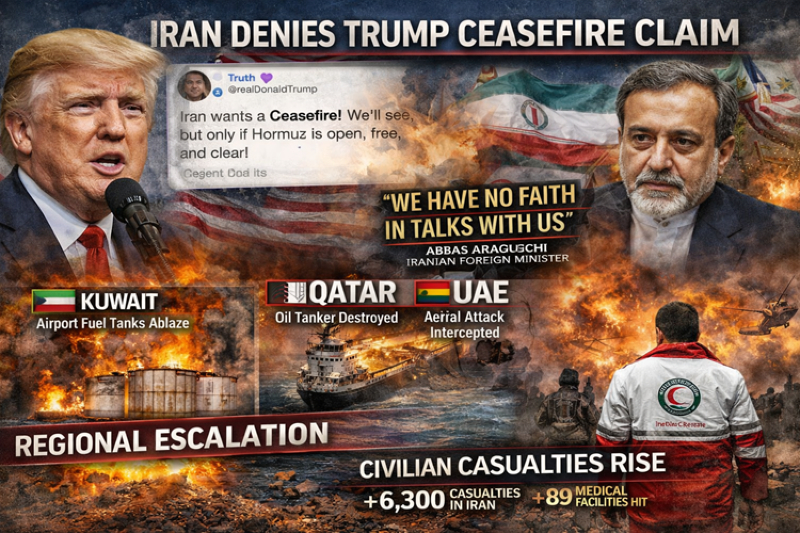
The diplomatic rift widened after President Trump took to social media to claim that Iran’s leadership had requested an end to hostilities. Trump signaled a conditional openness to the idea, stating he would only consider a ceasefire once the Strait of Hormuz—a vital artery for global oil—is "open, free, and clear."
However, Iranian Foreign Minister Abbas Araghchi swiftly countered this narrative in an interview with Al Jazeera. Araghchi stated he has "no faith" in discussions with the United States, clarifying that while messages have been received from Washington, no formal negotiations are currently underway.
Key Diplomatic Stance:
The US Position: Trump maintains a "maximum pressure" approach, vowing to continue military action until maritime routes are secured.
The Iranian Position: Officials label Trump’s claims as "ridiculous displays" and insist the Strait remains under the dominant control of the Islamic Revolutionary Guard Corps (IRGC).
Regional Fallout: Attacks in Kuwait and the UAE
The war’s geographic footprint expanded significantly today with reports of strikes hitting neutral and allied territories:
Kuwait: Authorities reported a "large fire" at fuel tanks near Kuwait International Airport following an Iranian attack.
Qatar: The Defence Ministry confirmed Iranian missiles struck an oil tanker within Qatari territorial waters.
UAE: The Emirati Defence Ministry reported a massive aerial engagement, claiming to have intercepted 5 ballistic missiles and 35 drones launched from Iran.
Humanitarian Crisis and Cultural Destruction
Inside Iran, the toll on civilian life and heritage is mounting. The Iranian Red Crescent reports that over 115,000 civilian units, including schools and hospitals, have been damaged.
"We are not talking about stone and mortar," said Reza Salehi Amiri, Iran’s Minister for Culture. "This is a deliberate attack on the memory and history of a people."
Health officials confirmed that at least 24 healthcare workers have been killed since the start of the US-Israeli operations, with over 330 medical facilities sustaining damage.
Political Pressure Mounts in Washington
As President Trump prepares for a prime-time address to the nation, he faces domestic criticism over the war’s economic impact. Democratic Senator Chris Coons argued that the "war of choice" is driving up costs for American families, citing rising prices for groceries, utilities, and gasoline.
Despite low approval ratings for the conflict, administration insiders suggest Trump will frame the current economic "short-term pain" as a necessary step to prevent a nuclear-armed Iran.
Global Market Reaction
In response to the volatility, Russia has announced a total ban on gasoline exports, citing the instability caused by the war. Meanwhile, European allies continue to distance themselves from the conflict, with French officials reminding the White House that NATO is not designed for operations in the Persian Gulf.
Latest Military Developments at a Glance
| Location | Event | Reported Impact |
|---|---|---|
| Kiryat Shmona, Israel | Hezbollah Rocket Strike | Extensive property damage; one civilian injured. |
| Southern Lebanon | Israeli Ground Advance | Intense fire exchange; four family members killed in Houmine El Tahta. |
| Damascus, Syria | Missile Interceptions | Explosions heard as air defenses engaged incoming projectiles. |
| Mianeh, Iran | US-Israeli Air Strike | Five civilians reported killed in a residential area. |
For the latest updates and casualty figures, follow our live tracker.
As of April 1, 2026, the human cost of the multi-front conflict is staggering, with Iranian casualties bearing the heaviest burden; human rights organizations report that at least 1,574 Iranian civilians and approximately 4,789 military personnel have been killed in the US-Israeli air campaign.
On the opposing side, the Israeli military has confirmed the deaths of 10 soldiers during ground operations in southern Lebanon and estimates that 29 civilians have been killed by retaliatory strikes, while the United States reports 13 service members killed in combat since the war’s inception on February 28.
The United Nations has also suffered direct losses, with at least three Indonesian peacekeepers killed in southern Lebanon due to escalating hostilities, highlighting a regional crisis that has now claimed thousands of lives across military and civilian sectors alike.