
Trump Claims Iran War Could End Within Weeks; Pope Urges "Off-Ramp" as Tehran Remains Skeptical
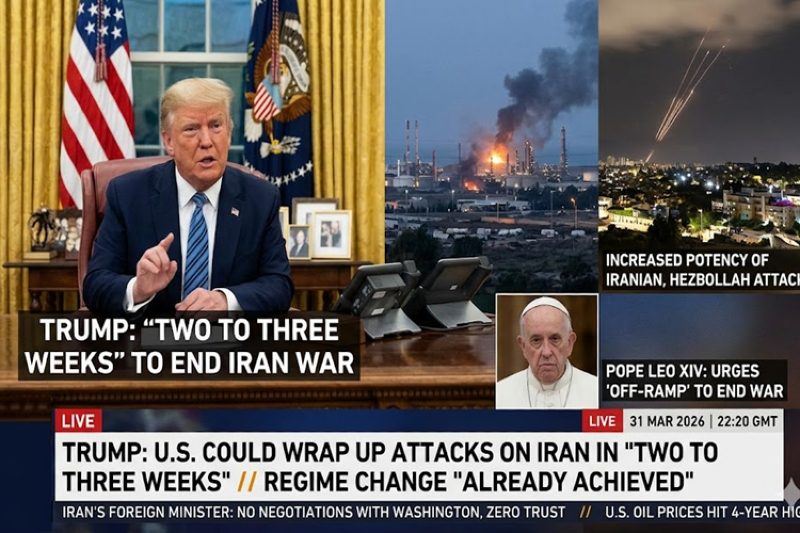
WASHINGTON/TEHRAN — U.S. President Donald Trump announced on Tuesday that the military campaign against Iran is rapidly approaching its conclusion, suggesting the conflict could be wrapped up in as little as "two to three weeks."
Speaking from the Oval Office, Trump asserted that the primary U.S. objective—preventing Iran from acquiring nuclear weapons—has been "attained." He further claimed that the U.S. does not require a formal negotiated settlement to cease hostilities, stating, "Iran does not have to make a deal for the U.S. to end the war."
Tehran’s Stance: Communication Without Negotiation
Despite Trump's optimistic timeline, Iranian officials remain deeply wary. Foreign Minister Abbas Araghchi confirmed to Al Jazeera that while messages have been exchanged between Washington and Tehran, the Islamic Republic is not engaged in formal negotiations.
Araghchi emphasized a profound lack of trust, describing the U.S. position as "excessive and unrealistic." Other Iranian diplomats echoed this sentiment:
Zero Trust: Officials stated there is no expectation that current communication channels will yield immediate results.
Commitment to Peace vs. Betrayal: Iran’s Ambassador to Pakistan, Reza Amiri Moghadam, noted that while Tehran remains a "peace-loving nation" open to dialogue, it feels betrayed by U.S. actions and "bad faith" during previous rounds of talks.
Internal Stability: Despite U.S. claims that "regime change" has effectively occurred, political analysts and Iranian sources insist the country’s political structure remains intact.
Escalation on the Ground
The talk of a quick exit comes amid a volatile military situation across the Middle East:
Strategic Shifts: Reports indicate that while the volume of Iranian missile fire has decreased, the "potency" and value of targets have increased, recently striking an oil refinery in Haifa and a power station in Hadera.
Regional Fallout: In Lebanon, Israeli airstrikes continue to take a heavy civilian toll, including a strike in Jebchit that killed a pregnant woman and her husband. Simultaneously, Hezbollah has ramped up rocket barrages against northern Israeli bases.
Economic Alarm: Global energy markets are bracing for extreme volatility. U.S. oil prices have hit a four-year high, and U.S. Senator Chris Murphy warned of a "global economic meltdown" if the Suez Canal is blocked following the closure of the Strait of Hormuz.
International Pressure
The international community is increasingly calling for a de-escalation "off-ramp." Pope Leo XIV made a rare direct appeal to President Trump to decrease the violence, while Russian President Vladimir Putin and UAE President Mohamed bin Zayed Al Nahyan expressed "profound concern" over civilian casualties and infrastructure damage.
Meanwhile, the U.S. State Department has issued "shelter in place" orders for its citizens in Saudi Arabia, citing credible threats against locations where Americans gather, underscoring that despite talk of an end date, the region remains on a knife-edge.
Flash Summary: The "Two-Week" Countdown to Peace?
As the conflict enters a critical phase, here are the high-stakes developments fueling global headlines:
1. The $4 Gas Crisis & Global "Meltdown"
Pain at the Pump: For the first time in nearly four years, U.S. gas prices have surged past $4.00 per gallon.
Supply Chokepoint: Experts warn of a "global economic melting" as the Strait of Hormuz remains under Iranian control.
With 20% of the world's oil passing through this artery, a total closure could send Brent crude skyrocketing well beyond $100 per barrel. Trade Risk: U.S. Senator Chris Murphy warned that if Iran’s Houthi allies successfully block the Suez Canal, 15% of global trade and 30% of container traffic could be paralyzed.
2. Iran’s "Deadly Accuracy" Shift
Quality Over Quantity: Military analysts note a chilling shift in Tehran’s tactics. While the total number of missiles has decreased, they are now striking "high-value" infrastructure, including:
The Haifa oil refinery and Beersheba chemical plant.
Israel’s strategic Hadera power station.
Nuclear Red Line: For the first time in the war, missiles reportedly struck near Israel’s Dimona nuclear research center, signaling a dangerous new phase of escalation.
3. The Pope’s First-of-its-Kind Appeal
A "Holy" Intervention: Pope Leo XIV, the first-ever American Pontiff, has broken diplomatic protocol with a direct appeal to President Trump.
The "Off-Ramp": Speaking from Castel Gandolfo, the Pope urged the White House to find a way to "decrease the amount of violence" before the Easter holiday, calling for an immediate return to the negotiating table.
4. Chaos in the Gulf & Kidnappings
Journalist Seized: The U.S. State Department is coordinating with the FBI following the reported kidnapping of an American journalist, Shelly Kittleson, in Baghdad. A suspect linked to Kata'ib Hezbollah is currently in Iraqi custody.
Civilian Targets: Beyond Israel, Iran-led strikes have hit a water desalination plant in Kuwait, while Saudi Arabia and Jordan have intercepted multiple drones and missiles over their territories in the last 24 hours.
5. The "No-Deal" Strategy
Trump’s Gambit: The President’s claim that he can end the war without a formal "deal" suggests a shift toward a unilateral declaration of victory.
Tehran’s Rebuttal: Iran’s Foreign Minister Araghchi has dismissed U.S. ceasefire conditions as "unreasonable," insisting that any end to the war must include legal guarantees against future attacks and compensation for infrastructure damage.
Economic Outlook: J.P. Morgan analysts project that if the Strait of Hormuz remains closed through April, regional production "shut-ins" could reach 12 million barrels per day, threatening a global recession by mid-2026.