
Trump Administration Reverses Key Climate Ruling on Greenhouse Gases
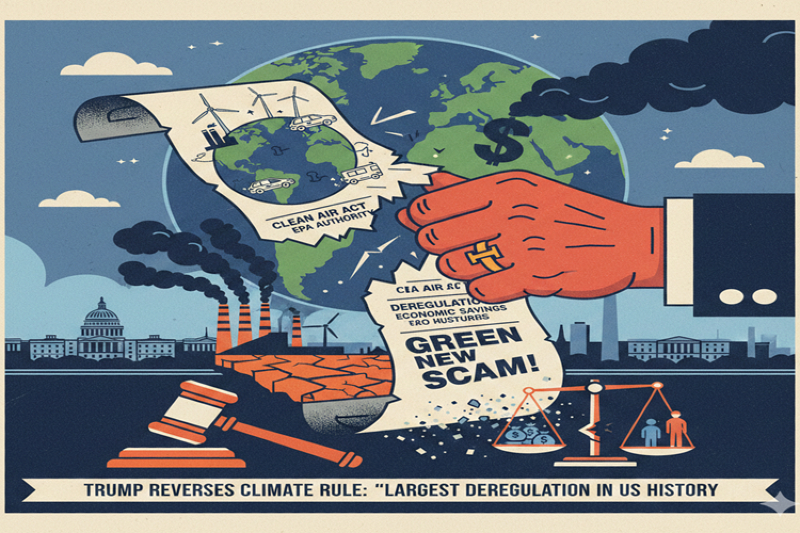
February 13, 2026: US President Donald Trump has revoked a landmark 2009 ruling, known as the “endangerment finding,” that classified certain greenhouse gases as a threat to public health.
The reversal effectively removes a legal foundation that has guided federal regulations aimed at reducing emissions from vehicles, power plants, and other industries.
White House Frames Reversal as Deregulation
The Trump administration described the move as “the largest deregulation in American history.” Officials said it would reduce costs for automakers, estimating a savings of $2,400 per vehicle, and claimed it could contribute to lowering energy and transportation costs nationwide.
Speaking in the Oval Office, President Trump criticized the 2009 rule as a “disastrous Obama-era policy” that hurt the US auto industry and increased costs for consumers. He also referred to the broader climate agenda of Democrats as the “Green New Scam.”
Environmental Groups Express Concern
Environmental advocates warned that the reversal could have serious public health consequences. Former President Barack Obama criticized the move, stating on X (formerly Twitter) that removing the finding would make Americans “less safe, less healthy and less able to fight climate change.”
Experts from the Environmental Defense Fund noted that the rollback could lead to higher fuel consumption, increased pollution, and adverse health outcomes, including more asthma attacks and premature deaths.
Legal and Regulatory Implications
The 2009 endangerment finding gave the Environmental Protection Agency (EPA) authority to regulate six key greenhouse gases, including carbon dioxide and methane. It has served as the cornerstone for federal efforts to limit emissions, particularly in the auto industry, energy sector, and other key industries.
Former EPA and Department of Justice attorney Meghan Greenfield explained that overturning the ruling affects a wide range of regulations, from vehicles and power plants to oil, gas, and waste management.
The ruling also previously limited state-level legislation on stricter emissions standards and blocked certain climate-related lawsuits. Legal experts anticipate that states and environmental organizations may challenge the reversal in courts, potentially pushing the issue to the Supreme Court.
Economic and Industrial Considerations
While the Trump administration emphasizes potential cost savings, some analysts and industry experts have raised concerns about global competitiveness. Michael Gerrard, a climate law expert at Columbia University, noted that relaxing fuel economy standards could make US vehicles less appealing internationally, affecting exports and overall market demand.
Scientific Debate Behind the Reversal
The reversal is partly based on a 2025 Department of Energy report that questioned the impact of greenhouse gases on climate change. Critics argue the panel was unrepresentative and biased, and that its conclusions are scientifically flawed.
Court rulings have already challenged the legal formation of the panel, and ongoing litigation is expected to test the Trump administration’s ability to permanently overturn the 2009 finding.
Legal analysts suggest that a Supreme Court decision could make the rollback effectively irreversible for future administrations without new legislation.
Global and Public Health Implications
Climate scientists emphasize that the endangerment finding has been critical to US efforts to curb emissions and protect public health. Reversing it could have long-term consequences for air quality, respiratory health, and environmental policy.
Observers note that the decision will likely fuel legal, scientific, and political debates over climate regulation in the United States for the remainder of Trump’s term and beyond.