
The Reporter24 Explainer: Why a Missing Pilot is Iran’s Ultimate Strategic Shield
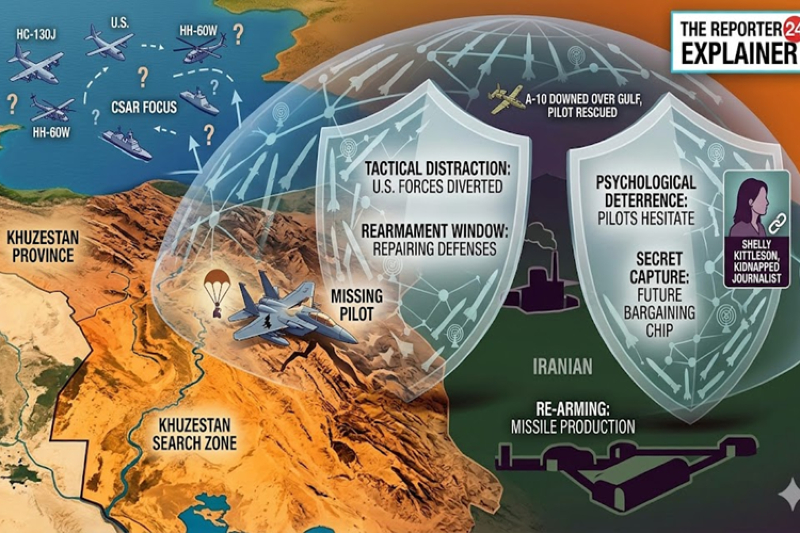
The downing of a U.S. F-15E Strike Eagle over Khuzestan and an A-10 Warthog in the Persian Gulf has shifted the gravity of Operation Epic Fury. Beyond the immediate tactical loss of two multi-million dollar airframes, the "missing pilot" scenario has handed Tehran a potent psychological and strategic lever.
While Washington scrambles to recover its untraced airman, a deeper look at the battlefield suggests that for Iran, this search is not just a pursuit—it is a calculated stall tactic.
1. The "Busy" Factor: Tactical Distraction
By keeping U.S. and Israeli assets occupied with high-risk Combat Search and Rescue (CSAR) missions, Iran effectively dictates the pace of the air war.
Asset Diversion: Every hour spent flying HC-130J and HH-60W helicopters at low altitudes is an hour that those same surveillance and strike assets are not targeting Iranian missile silos or command centers.
Psychological Toll: The "missing" status is a powerful deterrent. It erodes the confidence of Allied pilots who were previously told that Iranian air defenses were "decimated." Seeing a comrade untraced in enemy territory forces every pilot in the theater to second-guess their safety.
2. Buying Time for Rearmament
Tehran is using the current lull in large-scale strategic bombing—caused by the localized focus on the search zone—to repair and rearm.
Missile Production: While the U.S. focus is on a single coordinate in the Khuzestan highlands, Iran’s underground "missile cities" are likely working at maximum capacity to replace the batteries destroyed in the first four weeks of the war.
Capacity Restoration: With 70% of its steel production reportedly hit, Iran is in a desperate race to stabilize its industrial supply chain. Every day the U.S. is "busy" with a rescue is a day Iran uses to fortify its remaining infrastructure.
3. The "Ghost" Prisoner: A Strategic Insurance Policy
The most chilling possibility for the Pentagon is that Iran may have already captured the pilot and kept the information "off the books."
Human Shield Strategy: If Tehran holds a high-value American prisoner in secret, it gains a "strategic defense" tool. The mere suspicion of a prisoner’s presence at a specific military facility can deter U.S. strikes on that target.
Future Leverage: In any future ceasefire negotiations or prisoner swaps, a "ghost" pilot becomes the ultimate bargaining chip.
The Strategic Outlook
The shoot-down of the F-15E proves that Iran’s air defense network is far from extinct; it is adaptive. By dragging out the search and offering bounties to local tribes, Iran is successfully turning a rescue mission into a resource-draining stalemate.
For the U.S., the mission is a moral imperative: Leave no man behind. For Iran, that same mission is a golden opportunity to reset the board for a long-term war of attrition.
A Parallel Strategy: The Kidnapping of a U.S. Journalist
This calculated tactical delay mirrors another recent crisis: the kidnapping of a female American journalist Shelly Kittleson by Iranian-backed elements. Much like the search for the untraced pilot, the abduction serves the same strategic agenda for Tehran.
By forcing U.S. intelligence and special operations to pivot toward high-stakes hostage recovery, Iran successfully fractures the Pentagon’s focus.
Whether it is a downed aviator in the Khuzestan highlands or a captured member of the press, these "high-value targets" act as a collective human shield—slowing the pace of Allied strikes and providing Iran with the critical time it needs to rebuild its military capacity and industrial steel production.