
US Special Forces in High-Stakes Extraction: Iran Offers Bounty for Missing Airman
TEHRAN/WASHINGTON — A desperate search is underway across the rugged terrain of southern Iran as elite U.S. rescue teams and Iranian security forces race to locate a missing American weapon systems officer.
The airman’s F-15 fighter jet was downed on Friday, sparked a high-stakes confrontation that could dramatically shift the trajectory of the ongoing conflict.
According to reports, while the pilot of the aircraft was successfully extracted in a daring recovery operation, the second crew member remains unaccounted for. The Pentagon has confirmed that a second aircraft, an A-10 Warthog, also came under fire during the initial search-and-rescue (SAR) efforts, though its pilot was rescued after ejecting over the Persian Gulf.
The Rescue Mission: "The Swiss Army Knives of the Air Force"
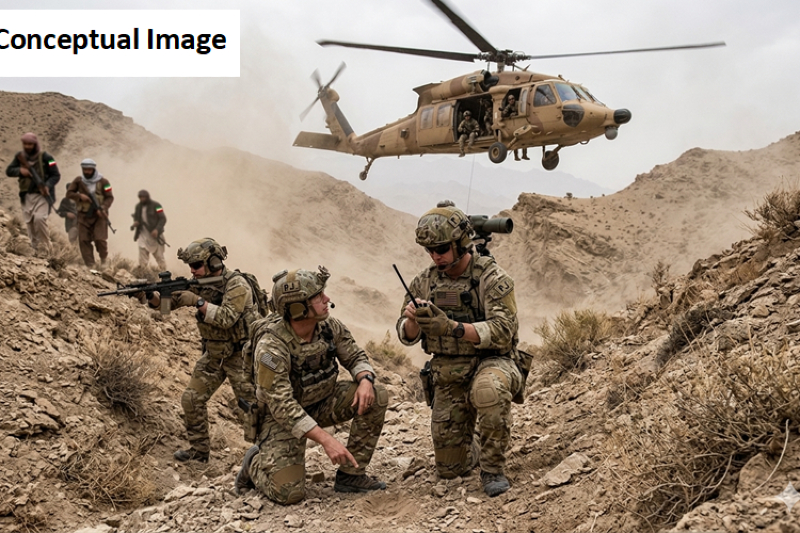
The U.S. has deployed its most elite Combat Search and Rescue (CSAR) units—specialists often referred to as the "Swiss Army knives of the Air Force." These teams, which include highly trained Pararescue Jumpers (PJs), operate with a level of expertise comparable to Navy SEALs but with advanced medical capabilities.
Operational Methods:
Aerial Insertion: Rescue missions typically utilize HH-60 Black Hawk helicopters supported by refueling tankers and fighter patrols.
SERE Tactics: The missing airman is trained in SERE (Survival, Evasion, Resistance, and Escape) protocols. Their primary objective is to move away from the ejection site immediately, utilize the terrain for concealment, and signal only when a secure "window" is established.
Medical & Tactical Extraction: Once contact is made, PJs are trained to provide trauma care under fire and defend the extraction point until the survivor is hoisted to safety.
The Iranian Pursuit: A "Systematic Manhunt"
Tehran has responded with a massive mobilization of both military and civilian assets. In a move that highlights the political value of a captive American service member, Iranian state media has announced a reward of approximately $66,100 (£50,000) for the airman’s capture—a staggering sum compared to the average local salary.
Iranian Strategies:
Civilian Mobilization: Unverified footage has emerged showing armed civilians and paramilitary groups scouring provinces like Khuzestan, carrying drones and small arms.
Psychological Warfare: Officials are urging citizens to capture the airman "alive," likely seeking a high-profile prisoner to use as leverage in international negotiations or for domestic propaganda.
Prospects and Perilous Challenges
The mission is described by military strategists as "the most dangerous mission in the world." Both sides face distinct hurdles:
1. Contested Airspace: The U.S. military is operating in an environment where air superiority is no longer guaranteed. The downing of the F-15 and the strikes on the A-10 prove that Iranian air defenses remain a lethal threat to slow-moving rescue helicopters.
2. The Detection Dilemma: For the missing airman, using a signaling beacon is a double-edged sword. While it alerts U.S. rescuers, it can also be detected by Iranian electronic surveillance, pinpointing their location for the "manhunt" teams.
3. The "Golden Hour": The first hour following a crash is critical for recovery. As time passes, the risk of dehydration, injury, and capture increases exponentially. With the search now entering its second day, the mission has moved into a "deep penetration" phase where the margin for error is zero.
4. Political Stakes: The Pentagon reports that 365 U.S. service members have been wounded and 13 killed since the start of the war on February 28. The capture of an airman would significantly escalate the political pressure on the Trump administration, potentially forcing a shift in military strategy.
As the sun sets over the Karun River, the silence of the Iranian desert is broken only by the hum of distant rotors and the footsteps of search parties, both sides knowing that the fate of one airman could decide the next chapter of the war.