
Beijing’s Great Wall of Oil: The 2026 Strategic Pivot after Death of Iran’s Supreme Leader Khamenei
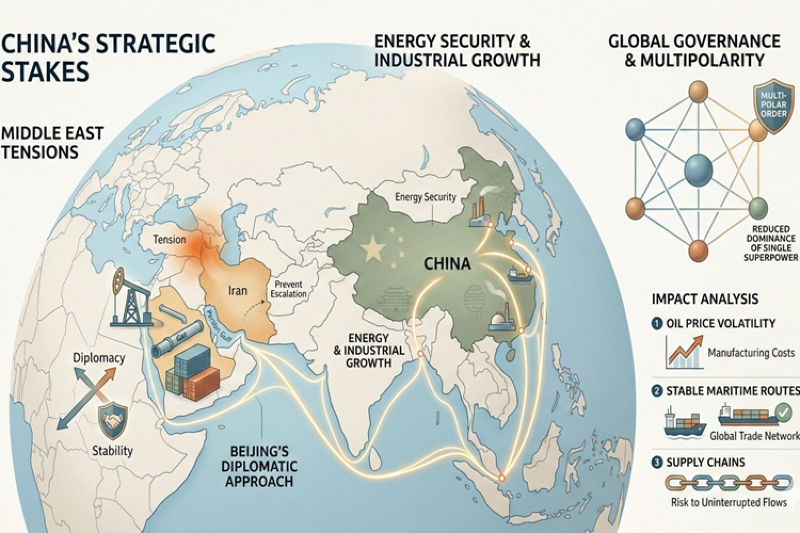
As of March 2026, Beijing has moved from a "cautious observer" to an "indirect stabilizer." The recent strikes on Tehran have triggered a state of high alert within the Zhongnanhai, as China’s 15th Five-Year Plan (2026–2030) faces its first existential threat following killing of Iran’s Supreme Leader, Ayatollah Ali Khamenei at US-Israel joint strike.
1. The Digital Shield: "Sovereignty over Software"
Beginning in early 2026, China initiated a clandestine strategy to replace Western software in Iran with closed Chinese digital ecosystems.
The Objective: To immunize Iranian infrastructure against cyber-sabotage by Mossad and the CIA.
The Assets: Intelligence reports suggest that just days before the February 28 strikes, China transferred loitering munitions (kamikaze drones) and advanced HQ-9 air defense components to Tehran under the guise of "technical cooperation."
2. Energy Security: The $100 Billion Headache
China remains the primary lifeline for Iranian crude, purchasing nearly 90% of Iran’s exports in 2025.
The "Teapot" Vulnerability: Small, independent refiners in Shandong province—known as "teapots"—depend entirely on discounted Iranian oil (trading at $8–$10 below global benchmarks).
Supply Chain Shock: Analysts warn that a total disruption of the Strait of Hormuz could force China to bid for expensive alternatives, potentially spiking global Brent prices by $10–$12 per barrel overnight and crippling the margins of China’s manufacturing sector.
3. The Geopolitical Gamble: Avoiding the "Russian Trap"
Beijing is walking a razor-thin wire between supporting an ally and avoiding secondary U.S. sanctions.
Regime Stability: For China, the nightmare scenario is not just higher oil prices, but a pro-American regime change in Tehran. Such a shift would dismantle the "Eurasian land bridge" and leave China surrounded by U.S.-aligned energy suppliers.
The Diplomacy of Restraint: While condemning the "unilateralism" of the U.S.-Israeli strikes, China has pointedly declined to offer a formal security guarantee, preferring to use BRICS+ and the SCO as diplomatic shields rather than deploying the People’s Liberation Army (PLA).
Impact Assessment: 2026 Forecast
| Indicator | Status | 2026 Outlook |
|---|---|---|
| Global Oil (Brent) | ⚠️ Bullish | Speculation of further strikes keeps Brent hovering near $78-$85/bbl. |
| BRI Projects | 🛑 Paused | Infrastructure in the Persian Gulf faces construction delays due to insurance risks. |
| Yuan Internationalization | ✅ Accelerated | Iran and Russia are pushing for a 100% Yuan-based energy clearing system. |
| Cyber Defense | 🛡️ Active | Integration of the "Great Firewall" tech into Iranian state networks. |
The Expert Verdict: "Beijing’s priority is 'Stability through Development.' They see the Middle East as a chessboard where the U.S. is playing to win, but China is playing not to lose. By securing Iran’s digital and energy borders, China aims to ensure that even if the region burns, the lights in Shanghai stay on."
Continue Reading 🔗
https://thereporter24.com/news/khamenei-killed-in-massive-us-israel-air-assault-as-iran-vows-devastating-retaliation