
"A Whole Civilization Will Die Tonight": Trump Issues Final Existential Threat to Iran as Deadline Looms
WASHINGTON D.C. / TEHRAN — The global community is bracing for what could be the most catastrophic military escalation in modern history.
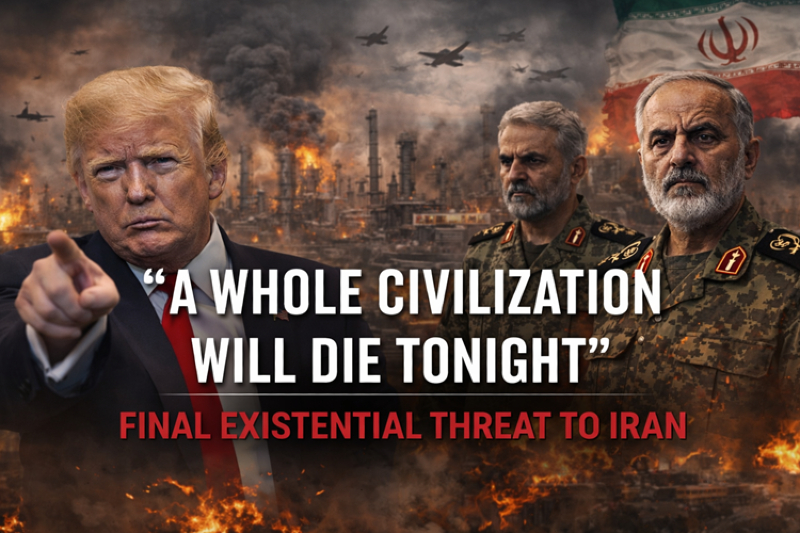
Following a series of intensified strikes, U.S. President Donald Trump has issued a chilling final warning to Tehran, declaring on social media that "a whole civilization will die tonight" if his 8:00 PM ET deadline for reopening the Strait of Hormuz is not met.
The "Existential" Ultimatum
Trump’s latest rhetoric marks a shift from targeting specific infrastructure to threatening the very existence of the Iranian nation. Writing on Truth Social, the President expressed a sense of grim inevitability: "I don’t want that to happen, but it probably will."
Analysts suggest this language is designed to shift the moral burden onto the Iranian leadership, frame the coming strikes as a consequence of Tehran’s own "intransigence."
The President’s frustration reportedly stems from Iran's strategy of targeting neutral civilian shipping and third-party states rather than engaging U.S. military assets directly. David Des Roches, a former U.S. defense official, noted that the White House feels "limited" in its ability to protect international waters without a massive, systemic strike on the Iranian mainland.
Domestic Backlash: Calls for the 25th Amendment
The President’s "civilizational" threat has triggered a firestorm in Washington. Former Congresswoman Marjorie Taylor Greene, once a staunch ally, condemned the rhetoric as "evil and madness," noting that not a single bomb has dropped on American soil. Greene, along with several Democratic lawmakers, has publicly called for the invocation of the 25th Amendment to remove Trump from office, arguing that the threat to destroy an entire civilization constitutes a war crime and evidence of a lack of fitness for office.
Tehran’s Defiance and the Oil Threat
In Tehran, the Islamic Revolutionary Guard Corps (IRGC) has remained defiant. Commanders warned that if the U.S. crosses "red lines" by hitting civilian facilities, the response will be felt far beyond the Middle East. The IRGC vowed to deprive the United States and its allies of global oil and gas supplies for "many years" through asymmetric warfare and the targeting of energy hubs.
Amidst this tension, a small diplomatic breakthrough occurred as Iran allowed two French nationals, Cecile Kohler and Jacques Paris, to depart the country after three years of detention. While France thanked Omani mediators for the release, the gesture has done little to cool the boiling tensions between Washington and Tehran.
Military Escalation and Peace Efforts
On the ground, the conflict continues to rage:
Israeli Strikes: Prime Minister Benjamin Netanyahu confirmed that the IDF has already begun crushing the "terror regime" by striking Iranian railways, bridges, and transport aircraft.
Missile Interceptions: Sirens echoed across Israel’s Negev desert today as a ballistic missile from Iran was intercepted. Hezbollah simultaneously launched drone attacks on northern Israel.
Pakistani Mediation: Despite the violence, Pakistani sources confirmed to Reuters that they are still working feverishly to facilitate a last-minute dialogue between the two nations before the Tuesday night "Infrastructure Midnight" deadline.
As the 20:00 ET window approaches, the world remains in a state of suspended terror, waiting to see if the "existential threat" issued from the White House will transform into a global conflagration.
Key Highlights of the Escalation:
Existential Warnings: President Trump issued his most severe threat to date, stating, “A whole civilization will die tonight,” as he prepares to follow through on pledges to dismantle Iran’s energy and transit networks if the Strait of Hormuz remains closed.
Infrastructure Under Fire: Following an urgent IDF warning for civilians to stay away from the national rail network, a missile strike has hit a strategic railway bridge in Kashan, Iran. Local reports confirm at least two fatalities in the attack, which underscores the coalition's focus on crippling Iranian logistics.
The IRGC's "Red Line": The Islamic Revolutionary Guard Corps (IRGC) has vowed a devastating asymmetric response. Commanders stated that any attack on civilian infrastructure would lead to a retaliatory campaign designed to deprive the U.S. and its allies of oil and gas "for many years" by targeting energy assets far beyond the immediate region.
Diplomatic Stalls: Despite intense mediation through Omani and Pakistani intermediaries, the White House maintains that Tehran’s concessions regarding the Strait of Hormuz do not meet the minimum requirements for a ceasefire.