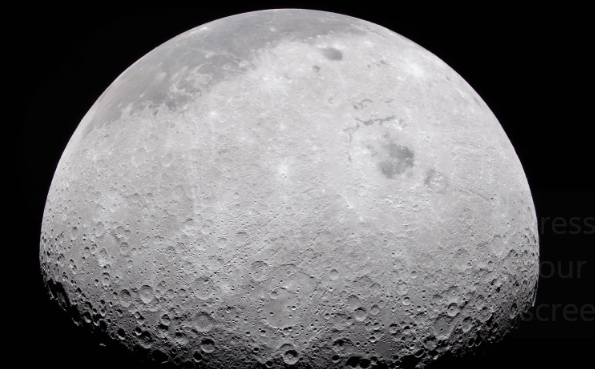
WASHINGTON, D.C. —A 4,000-kilogram upper-stage component from a SpaceX Falcon 9 rocket has collided with the lunar surface.
The impact occurred as scientists and space agencies prepare to analyze the resulting crater and evaluate the growing challenge of space debris.
Impact Details and Tracking
The spent rocket booster—roughly the size of a five-story building—was shed in space following a launch last year that carried a US-Japanese lunar mission.
While part of the Falcon 9 system is designed to return to Earth for reuse, this upper section was left adrift in an eccentric orbit that ultimately put it on a collision course with the Moon.
NASA's Center for Near-Earth Object Studies (CNEOS) confirmed the trajectory after independent astronomers utilized public tracking data. NASA emphasized that the event posed "no danger to Earth" and noted that the agency plans to collect valuable lunar data while refining deep-space tracking techniques.
Searching for Visuals and Before-and-After Craters
Because no spacecraft orbiting the Moon were positioned to capture the exact moment of impact live, confirmation relies heavily on ground-based telescopes and subsequent orbital imaging.
Dr. Matt Bothwell, an astronomer at the University of Cambridge, explained that the true scientific payoff will arrive in the coming days and weeks. Lunar orbiters—such as NASA's Lunar Reconnaissance Orbiter (LRO) and South Korea's Danuri spacecraft—will pass over the crash site to capture high-resolution before-and-after photographs of the newly formed scar.
The Growing Lunar Junkyard and Future Risks
According to science correspondent Pallab Ghosh, today's impact adds to a mounting accumulation of human-made hardware on the Moon.
Since the Soviet Union's Luna 2 reached the lunar surface in September 1959, approximately 3,000 human-made objects, weighing a combined total of roughly 190 tonnes, have been left on or around the Moon.
This inventory includes 796 items cataloged from NASA's Apollo program alone, alongside hardware from various international space agencies and commercial ventures.
While this debris poses no direct threat to a biosphere because the Moon lacks an atmosphere or ecosystem, scientists have highlighted three primary concerns:
Preserving Historic Sites: Protecting significant locations, such as the Apollo landing zones, from accidental disruption.
Protecting Pristine Science: Safeguarding untouched lunar soil, which holds billions of years of undisturbed geological history.
Mitigating Collision Risks: Managing orbital traffic, which is projected to rise sharply over the next decade as commercial lunar landings and missions increase.
https://plus.nasa.gov/video/farther-faster/