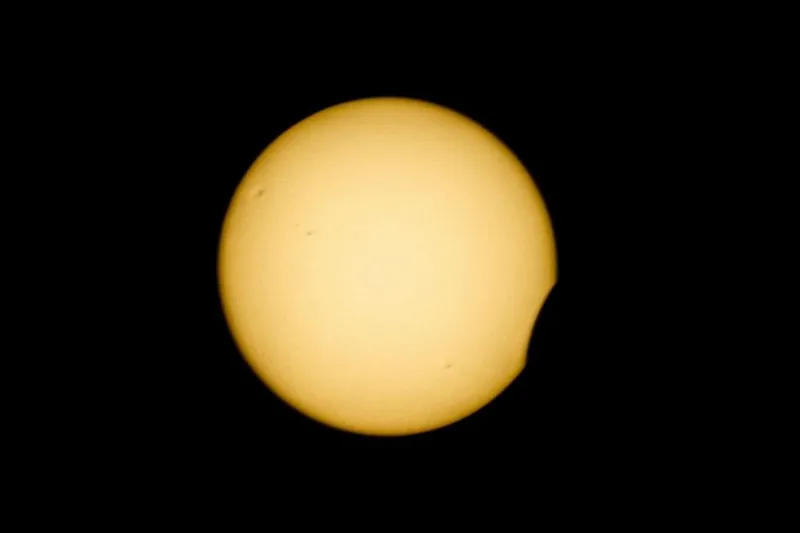
A total solar eclipse once again demonstrated one of the most extraordinary alignments in the night sky, as the Moon moved directly between the Earth and the Sun, temporarily blocking the Sun’s bright face from view.
For those watching the event, the most dramatic moment came when the Moon began moving away from the Sun. Slowly, sunlight returned to the sky, bringing the brief period of darkness to an end. Although totality lasted for less than two minutes, the rare spectacle left a lasting impression on observers.
A Remarkable Cosmic Coincidence
A total solar eclipse is possible because of an unusual relationship between the sizes and distances of the Sun and Moon. The Sun is around 150 million kilometres (93 million miles) from Earth, making it roughly 400 times farther from our planet than the Moon.
At the same time, the Moon is approximately 400 times smaller in diameter than the Sun. This unusual combination means that, when viewed from Earth, the two objects can appear almost identical in size in the sky.
That apparent similarity is what allows the Moon to completely cover the Sun during a total eclipse. When the alignment is precise, the Moon blocks the bright solar surface while allowing the Sun’s outer atmosphere, known as the corona, to become visible.
Why Total Eclipses Are So Rare
The spectacle is not simply a result of the Moon passing in front of the Sun. The Moon’s orbit around Earth is tilted, meaning the three celestial bodies do not line up perfectly during every new moon.
Even when an eclipse occurs, the Moon does not always appear large enough from Earth to cover the entire Sun. If the Moon were somewhat smaller or positioned farther away, its apparent size would be insufficient to hide the Sun completely.
This makes total solar eclipses a striking example of cosmic geometry. The conditions required for totality depend on a remarkably precise combination of distance, size and orbital position.
For skywatchers, those conditions create one of nature’s most dramatic displays. Daylight can briefly fade, temperatures may change, and the Sun’s normally hidden outer atmosphere can become visible.
The short duration of totality also adds to the event’s appeal. A few moments of complete solar coverage can become a memorable experience for people who have travelled long distances simply to witness the phenomenon.
While eclipses themselves are predictable, each total eclipse offers observers a different opportunity to experience the alignment of the Sun, Moon and Earth. The event serves as a powerful reminder that the appearance of our sky is shaped by precise astronomical relationships that have existed for billions of years.