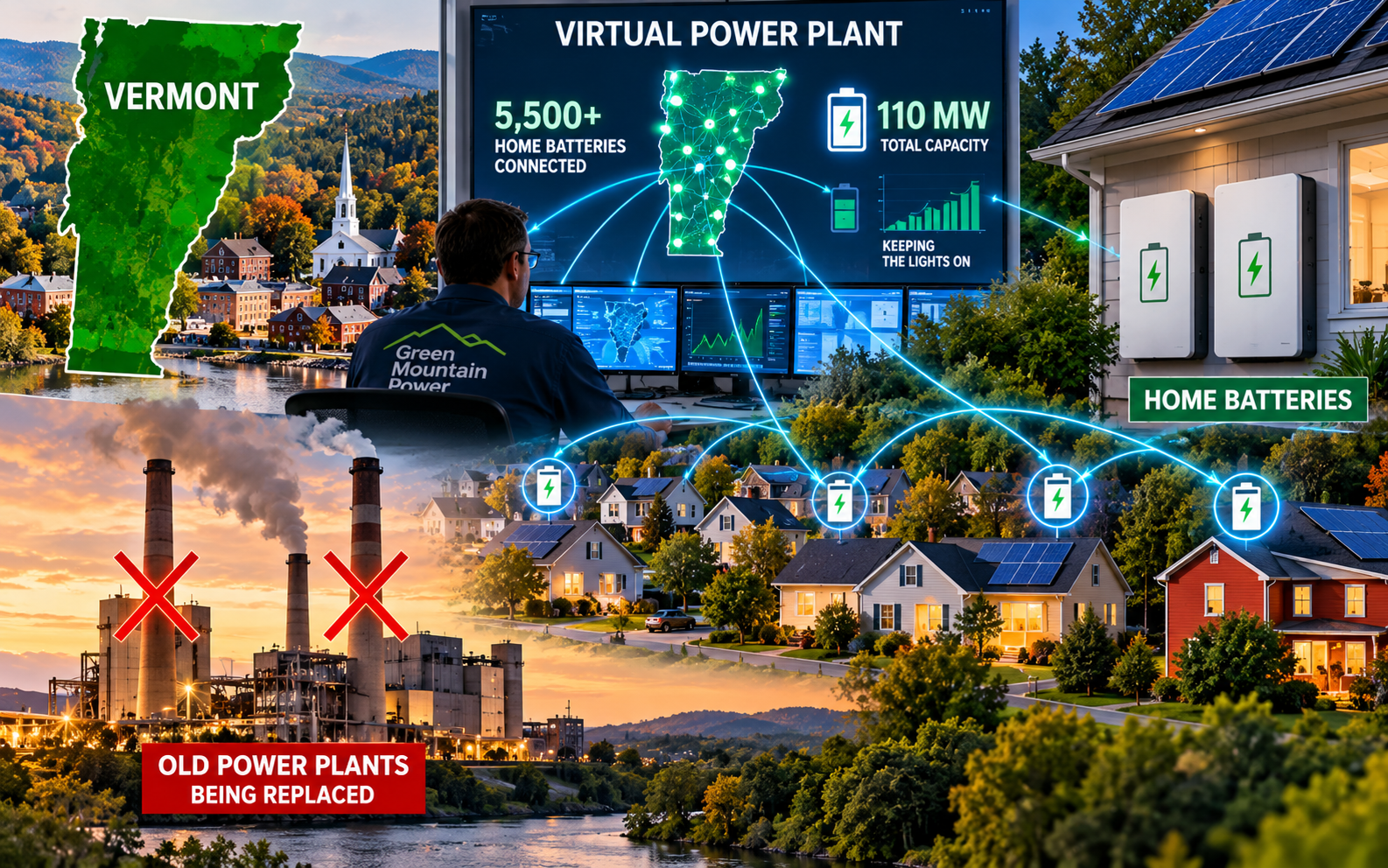
VERMONT — Thousands of household batteries are being connected across the US state of Vermont to create a large-scale “virtual power plant”, helping keep homes supplied with electricity during storms while reducing the need for conventional fossil-fuel power stations.
The initiative is being operated by Green Mountain Power (GMP), Vermont’s largest electricity utility. More than 5,500 customers have home battery systems that can provide backup electricity during outages while also supporting the wider power grid.
Instead of generating electricity at one central location, a virtual power plant connects large numbers of batteries and other distributed energy resources through software.
The utility can coordinate those devices and draw on stored electricity when demand rises or the grid comes under pressure.
GMP’s virtual power plant has reached about 110 megawatts of capacity, comparable to a small-to-medium natural gas power station.
More than half of that capacity comes from residential battery systems, with utility-scale storage and other resources making up the remainder.
The system is particularly significant in Vermont, where severe storms can leave rural communities without electricity. According to GMP, seven of the 10 most damaging storms in its history occurred during the past decade, causing more than $225 million in damage.
For participating households, batteries can automatically provide electricity when the main grid fails.
Depending on consumption, a typical installation can keep essential household equipment operating for an extended period without the noise and emissions associated with petrol or gas-powered generators.
GMP offers some customers two home batteries for $55 a month under a 10-year lease. One Vermont resident featured in the programme had considered spending about $12,000 on a conventional generator before choosing batteries instead. Her household has experienced no loss of electricity since the system was installed in 2024.
The batteries serve another important purpose when the electricity network faces peak demand. GMP can draw stored electricity from participating systems while maintaining reserve power for customers.
This reduces the amount of expensive electricity the utility needs to purchase during periods of unusually high consumption.
During an extreme heat event in July 2026, GMP said its network of residential and utility-scale batteries supplied 90MW during a peak period, reducing costs by an estimated $6 million in a single peak hour.
The utility said the amount was equivalent to temporarily removing the demand of about 50,000 homes from the grid.
The expansion of battery storage is also changing Vermont’s reliance on traditional “peaker” plants. Such facilities, often powered by fossil fuels, are designed to operate when electricity demand suddenly rises. They may run relatively infrequently but must remain available to meet periods of maximum demand.
GMP says the reliability of its battery network has already enabled it to permanently close two peaker generating plants, in Vergennes and Rutland, following the required review by regional grid operator ISO New England.
The company intends to retire additional peaker plants as its stored-energy network expands.
The programme began as a pilot in 2017 and expanded substantially after Vermont regulators removed enrolment limits in 2023. More than 2,500 customers have joined since the cap was lifted.
Some households combine their batteries with rooftop solar panels, allowing locally generated renewable electricity to be stored for later use. However, a virtual power plant does not itself generate electricity. Its main function is to coordinate batteries, solar installations and other distributed resources so that available energy can be used more efficiently.
The concept is expanding beyond Vermont. The United States already has more than 40 gigawatts of virtual power plant capacity, according to Wood Mackenzie analysis cited by the BBC.
A 2025 US Department of Energy assessment estimated that as much as 160GW could be available by 2030 — equivalent to around 20% of projected US peak electricity demand.
Vermont’s experience suggests that thousands of relatively small batteries scattered among ordinary homes can collectively perform some of the functions traditionally assigned to large power stations.
Alongside providing households with backup electricity during storms, the network can help manage peak demand, reduce electricity costs and allow some fossil-fuel peaker plants to be retired.