
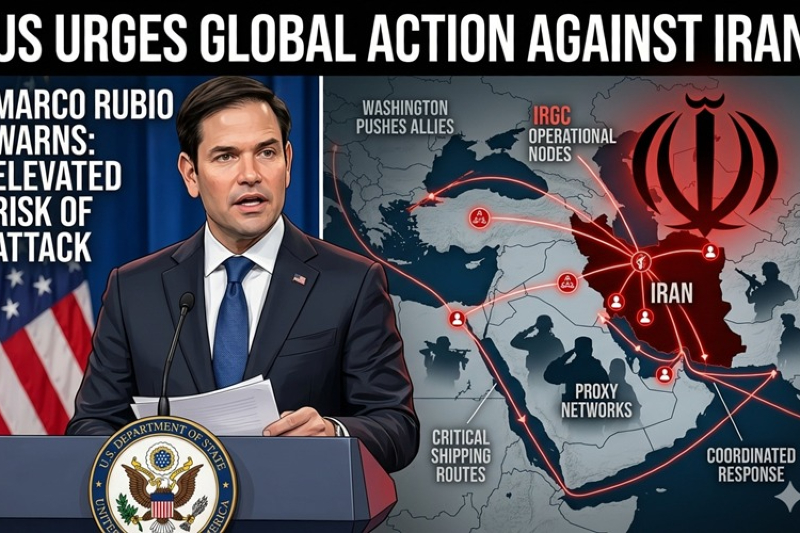
US Urges Global Action Against Iran as Marco Rubio Warns of ‘Elevated Risk of Attack’
The United States has stepped up diplomatic pressure on countries worldwide, urging swift action against Iran amid growing security concerns.
Secretary of State Marco Rubio has instructed American diplomats to engage foreign governments at the highest levels, warning of an increased threat linked to Tehran and its allied groups.
According to diplomatic communications, U.S. officials have been directed to encourage immediate measures aimed at weakening Iran’s ability to carry out attacks through its regional and global networks.
Push for Coordinated Global Response
The directive emphasizes the importance of collective international action, suggesting that joint efforts would be more effective than isolated moves by individual countries. U.S. policymakers believe that increased global pressure could force changes in Iran’s strategic behavior.
Diplomats have been asked to deliver this message urgently, highlighting concerns over activities linked to Iran’s powerful military wing, the Islamic Revolutionary Guard Corps (IRGC), as well as affiliated organizations.
Focus on Proxy Groups and Security Threats
Washington has pointed to Iran’s longstanding support for groups such as Hezbollah and other regional militias, accusing them of destabilizing governments and threatening civilian safety. U.S. officials argue that these networks play a central role in extending Iran’s influence beyond its borders.
The diplomatic outreach also includes calls for countries that have not yet done so to formally designate the IRGC and allied groups as terrorist organizations, a move seen as key to tightening international restrictions.
Broader Strategic Goals
The initiative is part of a wider U.S. effort to build international backing for its ongoing campaign against Iran. President Donald Trump has indicated that a coalition of supportive nations could soon be announced.
Officials say the broader objectives include limiting Iran’s nuclear and missile capabilities, disrupting its proxy networks, and reducing its military reach in critical regions, including key global shipping routes.
Rising Tensions
The latest diplomatic push comes as tensions in the Middle East continue to escalate, with ongoing conflict raising fears of wider regional instability.
Analysts suggest that Washington’s strategy reflects growing urgency to counter perceived threats before they intensify further.