
US Supreme Court Order Limits Use of Race in Electoral Maps, Raises Concerns Over Minority Voting Power
WASHINGTON, D.C., April 29, 2026 — The Supreme Court of the United States has issued a landmark ruling that restricts how race can be considered when drawing electoral district maps, a decision expected to influence political strategies across several states.
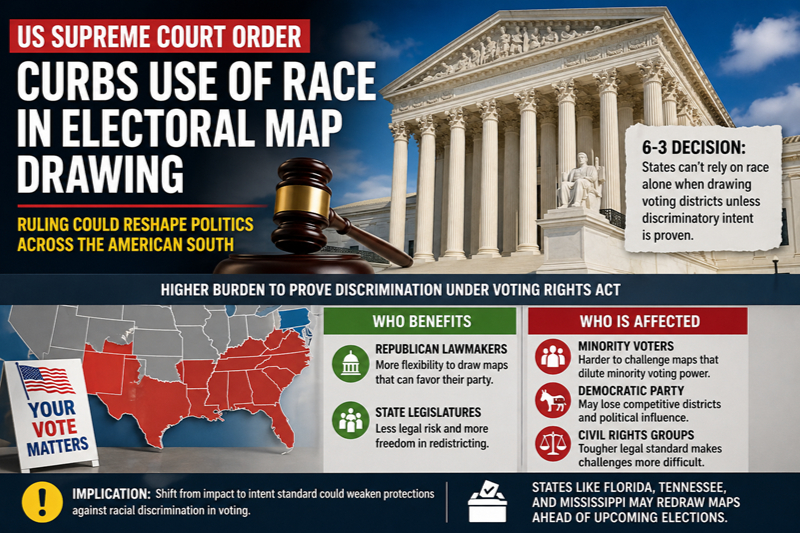
In a 6–3 verdict, the court’s conservative majority sided with challengers to a redistricting plan in Louisiana, where new voting boundaries had been created to comply with protections under the Voting Rights Act of 1965.
The ruling marks a significant shift in how courts interpret legal safeguards designed to protect minority voters.
Majority Opinion Raises Constitutional Concerns
Writing for the majority, Justice Samuel Alito argued that previous interpretations of federal law had, in some cases, compelled states to rely too heavily on race when designing districts.
He stated that such practices risk conflicting with constitutional principles that prohibit race-based decision-making.
The court stopped short of invalidating the Voting Rights Act itself but introduced a stricter standard for legal challenges.
Plaintiffs must now demonstrate clear intent by lawmakers to disadvantage minority voters, rather than relying solely on the impact of district boundaries.
Dissent Warns of Setback for Minority Rights
In a strongly worded dissent, Justice Elena Kagan cautioned that the decision could weaken longstanding protections for racial minorities.
She argued that the ruling may undermine efforts to ensure fair electoral representation and equal voting opportunities.
Political Impact Across Key States
The decision arrives at a time of intense political competition over redistricting, with both major parties seeking advantages in upcoming elections.
States such as Florida, Tennessee, and Mississippi are already reviewing or revising their electoral maps, and the ruling may give lawmakers greater flexibility in those efforts.
Supporters of the decision, including officials from the White House, described it as a victory for equal treatment under the law. Critics, however, warn it could make it more difficult to challenge maps that dilute the influence of minority voters.
Broader Implications for US Elections
Legal experts believe the ruling could reshape electoral dynamics, particularly in the American South, where district boundaries often play a decisive role in determining political control.
By raising the bar for proving discrimination, the court has altered the legal landscape for future voting rights cases.
The long-term effects of the decision are likely to unfold in the coming months, as states move forward with redistricting plans and potential legal challenges emerge.
The ruling by the Supreme Court of the United States isn’t just technical—it has clear political and social consequences. Here’s what it really means in practice:
Who Benefits?
1. Republican Party (in many Southern states)
In states like Florida, Texas, Mississippi, and Tennessee, Republican lawmakers often control the redistricting process. With fewer legal restrictions on considering race:
- They can redraw districts in ways that may favor their candidates.
- It becomes harder for opponents to challenge maps in court.
👉 Result: Greater chance of maintaining or increasing Republican seats in Congress and state legislatures.
2. State Legislatures (overall)
Lawmakers now have more freedom and less legal risk when drawing electoral maps.
- They no longer need to carefully balance racial representation to avoid lawsuits.
- The burden of proof is now much higher for those challenging maps.
👉 Result: More power shifts from courts to politicians.
Who Is Affected (Potentially Negatively)?
1. Racial Minority Voters (especially Black Americans)
Previously, under the Voting Rights Act of 1965, maps could be challenged if they reduced minority voting strength.
Now:
- You must prove intentional discrimination, not just unfair impact.
- That’s much harder to prove in court.
👉 Result:
Minority communities may lose influence in elections, especially in areas where their votes could be spread across multiple districts (a tactic often called dilution).
2. Democratic Party
Democrats often rely on strong support from minority voters.
- If minority voting power is weakened, Democratic candidates may lose competitive districts.
- This could affect control of the House of Representatives.
👉 Result: Potential electoral disadvantage in key states.
3. Civil Rights Groups
Organizations that challenge unfair maps now face a tougher legal battle.
- More evidence is needed.
- Fewer cases may succeed.
👉 Result: Reduced ability to fight discriminatory districting.
Big Picture Impact
- The ruling shifts focus from “effect” → to “intent”
- It makes it easier to defend controversial electoral maps
- It may reshape political power, especially in the American South
Simple Summary
- ✅ Benefited: Republican lawmakers, state governments
⚠️ Affected: Minority voters, Democrats, civil rights advocates
In the U.S. context, “minority voters” refers to people from racial or ethnic groups that are smaller in number compared to the overall (historically white-majority) population.
Who are considered minority voters?
Typically, this includes:
- Black or African American voters
- Hispanic / Latino voters
- Asian American voters
- Native American / Indigenous voters
People from mixed or other non-white backgrounds
What does it mean in elections?
The term is used especially in discussions about voting rights and electoral maps. Laws like the Voting Rights Act of 1965 were designed to ensure these groups:
- Are not unfairly excluded from voting
- Have a fair chance to elect representatives
Are not weakened by district maps that split or dilute their voting strength
Simple example
If a city has a large Black population but electoral districts are drawn in a way that spreads those voters across many areas, their collective voting power can be reduced. That’s why minority voters are often central to legal debates about fair representation.
In short
Minority voters = racial/ethnic groups with smaller population share whose voting power needs legal protection to ensure fair representation.