
Trump Issues "Negotiate or Decimate" Ultimatum as Vance Arrives in Islamabad for High-Stakes Peace Talks
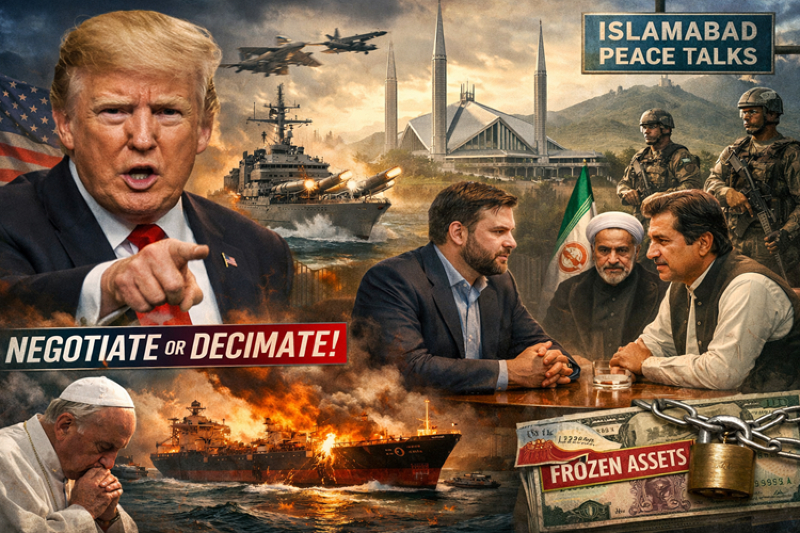
WASHINGTON/ ISLAMABAD The prospect of a diplomatic breakthrough in the Middle East hangs by a thread as U.S. Vice President JD Vance arrived in Pakistan for emergency peace talks, overshadowed by a series of incendiary warnings from President Donald Trump and a list of rigid preconditions from Tehran.
Negotiations are scheduled to begin Saturday in Islamabad, which has been transformed into a high-security fortress with paramilitaries patrolling the streets.
However, both nations have spent the preceding 24 hours engaging in aggressive brinkmanship that threatens to derail the summit before it starts.
"The Only Reason They Are Alive"
In a series of late-night statements on Truth Social and a phone interview with the New York Post, President Trump escalated his rhetoric to a fever pitch. He claimed that the Iranian government has "no cards" left to play beyond the "short-term extortion" of international waterways.
"The only reason they are alive today is to negotiate!" Trump posted, later adding that U.S. warships are currently being "loaded up with the best weapons ever made" in preparation for "complete decimation" should the Pakistan talks fail.
Vice President Vance, leading the American delegation, echoed this firm stance but maintained a sliver of diplomatic space, stating he would work with Iran if they act in "good faith," while warning that the U.S. will not be "played."
Tehran’s Preconditions: Lebanon and Frozen Assets
Despite the U.S. delegation's arrival, Iran has yet to officially confirm its presence at the table. Parliament Speaker Mohammad-Bagher Ghalibaf, a figure with close ties to the IRGC, signaled that two "non-negotiable" measures must be implemented before formal dialogue begins:
Lebanese Ceasefire: A total halt to Israeli military operations in Lebanon.
Asset Release: The immediate unfreezing of Iranian assets currently blocked by the U.S.
Iranian Foreign Minister Abbas Araghchi reinforced this position, accusing Washington of failing to adhere to "commitments" regarding the scope of the two-week ceasefire.
Tehran insists the truce must include Lebanon, whereas the U.S. and Israel have treated Lebanon as a separate theater of operations.
Ongoing Hostilities and "Collateral Damage"
While diplomats prepare for talks, the ground reality remains violent. Israeli strikes recently hit Nabatieh in southern Lebanon, reportedly killing 13 state security personnel.
The escalating human cost drew a rare and sharp rebuke from Pope Leo XIV, who took to X (formerly Twitter) to condemn the violence as "absurd and inhuman." The Pontiff warned that no "disciple of Christ" can support the dropping of bombs and lamented that civilian lives are being treated as "collateral damage of self-interest."
The "Critical" Crisis at the Strait of Hormuz
Beyond the humanitarian crisis, the economic "Strait-jacket" remains the primary driver of the U.S. ultimatum. Intertanko, the international body representing oil tanker owners, has advised its members to avoid the Strait of Hormuz entirely, describing the threat level as "critical."
The organization rejected the notion of an "Iranian toll" for passage—a proposal rumored to be on the negotiation table—calling it a violation of international law. Currently, the waterway remains under the de-facto rule of the Iranian military, with only a "trickle" of sanctioned vessels traversing the route, keeping global oil prices at record highs.
Essential Briefing: What You Need to Know
The Venue: Islamabad, Pakistan, acting as the primary mediator.
The Deadline: President Trump suggested the world would know "in about 24 hours" if a deal is possible.
The Stick: U.S. warships are reportedly "loading up" for potential strikes if diplomacy fails.
The Carrot: A "broad understanding" or framework to extend the current two-week ceasefire into a permanent truce.
With former Pakistani UN representative Maleeha Lodhi expressing "cautious optimism" for at least a mutual understanding of positions, the next 48 hours will determine if the region moves toward a fragile peace or a “complete decimation.”