
Tensions Mount: Trump Slams Iran’s Hormuz ‘Blackmail’ as Israeli Strikes Threaten Ceasefire Talks
WASHINGTON/ ISLAMABAD —The fragile path toward a regional peace deal hit significant turbulence on Friday as U.S. President Donald Trump accused Tehran of violating standing agreements, while a massive Israeli air campaign in Lebanon threatened to derail upcoming high-stakes negotiations in Pakistan.
Trump Warns Iran Over Strait of Hormuz
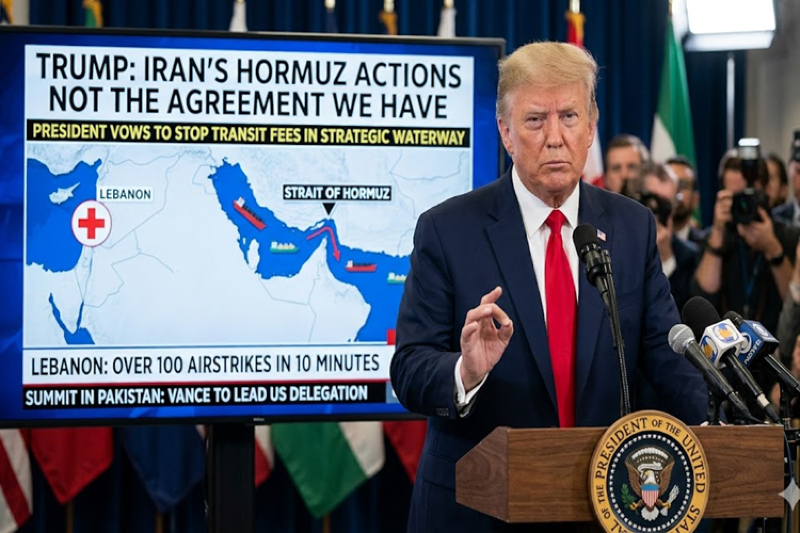
President Trump lashed out at Tehran over reports that Iran has begun "charging fees" to vessels attempting to navigate the Strait of Hormuz. The waterway, a global chokepoint responsible for 20% of the world’s oil and LNG, remains largely paralyzed despite a supposed two-week pause in hostilities.
"They better not be, and if they are, they better stop now," Trump posted to Truth Social, labeling Iran's conduct a "very poor job" and asserting that the current disruption was "not the agreement we have."
Market data underscores the crisis: only a handful of vessels are currently transiting the strait, leaving over 600 ships stranded. Analysts suggest Iran is using its control of the waterway as a "card" to demand the total removal of U.S. sanctions, seeking a return to the global economy.
Israeli Blitz Clouds Lebanon Peace Prospects
The diplomatic friction coincides with a dramatic escalation by the Israeli military. On Wednesday, Israel launched a "blitz" of over 100 air strikes in just 10 minutes, followed by continued bombardments through Thursday.
While Prime Minister Benjamin Netanyahu indicated a willingness to begin direct talks with the Lebanese government regarding the disarmament of Hezbollah, he remained defiant on the battlefield. "There is no ceasefire in Lebanon," Netanyahu stated, even as President Trump claimed the Israeli leader had agreed to "low-key it" to support the peace process.
A Humanitarian Catastrophe
The human cost of the renewed violence is staggering. In Lebanon, the Ministry of Health reported over 300 dead and 1,150 wounded in a single day.
Hospital Crisis: WHO Chief Tedros Adhanom Ghebreyesus warned that evacuation orders in Beirut have placed two major hospitals in peril. With 450 patients—including 40 in intensive care—and no alternative facilities available, medical officials say moving them is "operationally unfeasible."
Widespread Starvation: Displaced families in Beirut are increasingly facing acute hunger. Images from the capital show crowds of desperate residents, including children, lining up for meager food donations as the conflict displaces more than a million people.
Gaza Gridlock: The situation remains equally dire in Gaza, where aid organizations report that critical medical supplies and fuel for hospital generators remain blocked by Israeli authorities, six months after a separate ceasefire was established there.
Pakistan to Host High-Level Peace Talks
Despite the escalating violence, diplomatic efforts are shifting to Islamabad this weekend. Pakistan is set to host a pivotal summit between Washington and Tehran.
| Delegation | Key Representatives |
|---|---|
| United States | Vice President JD Vance, Steve Witkoff, Jared Kushner |
| Iran | Speaker Mohammad Bagher Ghalibaf, FM Abbas Araghchi |
| Host | Prime Minister Shehbaz Sharif |
The talks aim to formalize a lasting truce, though the two sides remain fundamentally divided. Iran views the Israeli attacks in Lebanon as a breach of the preliminary accord, while U.S. and Israeli officials maintain that the Lebanon front was never part of the initial ceasefire terms.
As South Korea dispatches special envoys to ensure the safety of its stranded vessels, the global community watches Islamabad to see if diplomacy can survive the mounting chaos on the ground.