
Bangladesh Litchi Industry Faces Yield Drop in Dinajpur: Climate Challenges and Economic Resilience
Dinajpur Litchi Economy 2026: Low Fruit Yields vs. High Market Demand in Bangladesh
Dinajpur, Bangladesh, April 26, 2026 — In the northern plains of Dinajpur, Bangladesh, summer is defined by more than just the rising heat; it is marked by clusters of crimson hope hanging from the branches.
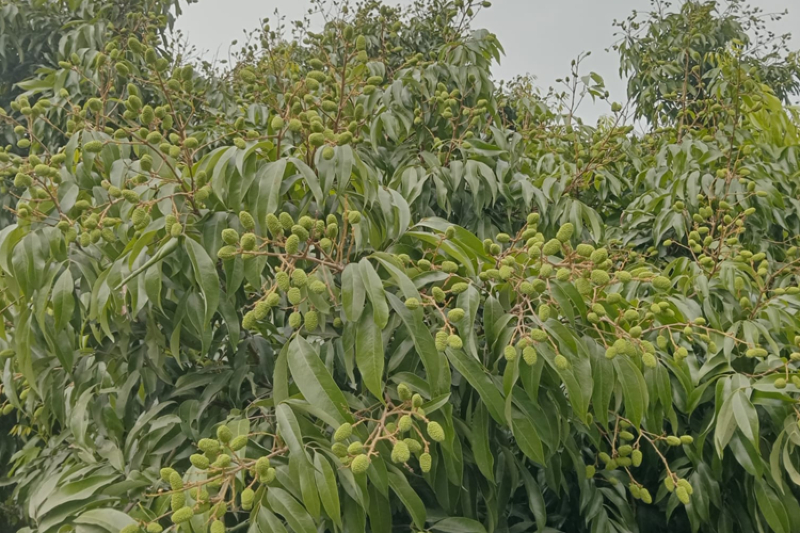
The litchi, often affectionately called a “natural rosogolla,” has reached its critical fruit-setting stage. However, this season brings a noticeable quiet to the orchards: fruit sets are sparser, fueling a wave of concern among local farmers and international traders.
Azizul Islam of Maheshpur village in Biral upazila is a clerk by profession, but in practice, he is a seasonal architect of the litchi economy. What began as a modest venture seven or eight years ago has blossomed into a business worth millions of Bangladeshi taka. Annually, he invests between 3 to 5 million taka into these orchards; this year, he has already committed approximately 3.5 million taka across several plots.
Yet, the current ledger reflects a challenging reality for the region.
“Only 40 to 50 percent of the trees have successful fruit sets. We are taking every possible measure to protect them, but the unpredictability of the weather remains our greatest anxiety,” he explains, his tone a mix of business calculation and quiet worry.
This unease is mirrored in the orchards of Amzad Hossain from Madhabbati. There, broken branches from recent storms and prematurely dropping fruit paint a fragile picture of the harvest in this part of Bangladesh.
“Less than half of my trees have fruit sets. Even with the regular application of pesticides, many are falling off. At this point, everything rests in the hands of nature,” he shares, his voice heavy with uncertainty.
Despite these local concerns, agricultural officials in Bangladesh maintain a perspective of measured optimism.
Sub-Assistant Agriculture Officer A.S.M. Hanif notes:
“Roughly 250 hectares are under litchi cultivation in this specific area. Currently, 50 to 60 percent of the trees carry fruit sets. We are providing constant advisory services to farmers to help preserve the remaining crop. While production may be lower, market prices are expected to stay high.”
Upazila Agriculture Officer Rumman Akter provides further detail:
“Across 12 unions, 2,558 hectares are dedicated to litchi. Although early blossoms looked promising, subsequent storms and hail caused significant damage. Nevertheless, 70 to 80 percent of trees are now carrying fruit sets. Our field workers are actively assisting farmers to minimize further losses. We are also focused on strengthening the litchi-based economy and exploring potential export channels from Bangladesh to global markets.”
At the district level, the scope of the industry becomes even clearer.
Md. Anisuzzaman (Crops), Additional Deputy Director of the Department of Agricultural Extension, observes:
“Litchi is cultivated on 5,870 hectares across 5,418 orchards within 13 upazilas of Dinajpur, Bangladesh. Despite the early weather setbacks, 60 to 70 percent of the trees have fruit sets. We anticipate a yield of 6 to 8 metric tons per hectare. With improved management and the expansion of exports, farmers can still secure strong returns.”
However, beyond the environmental hurdles, a structural challenge remains—market infrastructure.
Mintu Mia, a leader of the district’s raw produce traders’ association, argues:
“Every year, litchi worth 6 to 7 billion taka is traded in Dinajpur. When accounting for related industries, the market exceeds 10 billion taka ($85 million USD). Yet, inadequate market facilities often force us to sell at lower prices. A modern, dedicated marketplace is now an urgent necessity for Bangladesh to reach its full economic potential in this sector.”
Caught between the volatility of nature and harsh economic realities, the resilient litchi of Bangladesh remains a symbol of survival.
The fruit sets may be fewer this year, but the aspirations of the people remain undiminished.
For within every litchi lies more than mere sweetness—it carries the weight of a season’s hope, the heartbeat of a regional economy, and the enduring promise of a livelihood painted in deep red.