
Beijing Welcomes KMT’s Cheng Li-wun: A High-Stakes Gambit for "Peace"
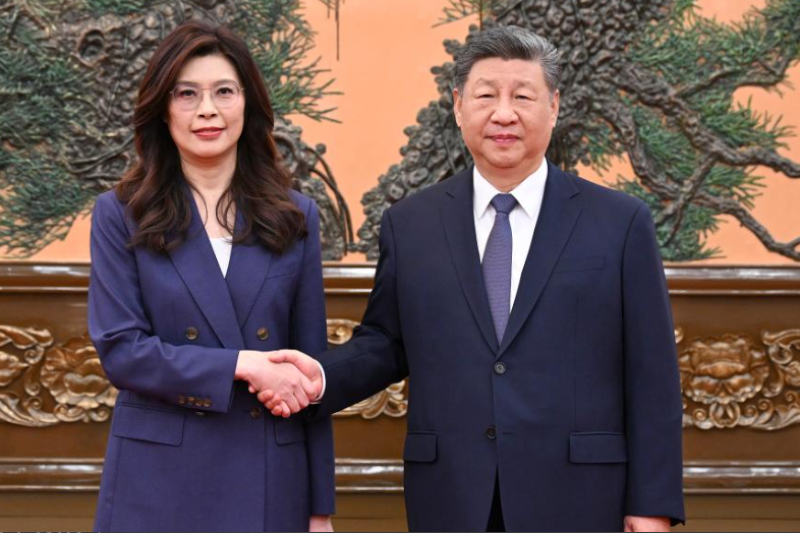
BEIJING – In a move that has sent shockwaves through the Indo-Pacific, Chinese President Xi Jinping welcomed Taiwan’s opposition leader, Cheng Li-wun, to the Great Hall of the People on Friday.
The meeting marks the first time a sitting Kuomintang (KMT) chairperson has stepped foot in the capital for high-level talks in a decade, signaling a high-stakes shift in the cross-strait chess match.
Amidst a backdrop of frozen official communications between Beijing and Taiwan’s ruling Democratic Progressive Party (DPP), Xi and Cheng traded rhetoric of "peace" and "shared rejuvenation." However, beneath the diplomatic pleasantries lies a calculated political maneuver aimed at the heart of Taiwanese domestic policy.
The "Peace" Offensive
During the closed-door session, Xi Jinping doubled down on the narrative of inevitable reunification, stating that "no matter how the international landscape evolves," the momentum for both sides to "come together" remains unchanged. He emphasized that dialogue is contingent on one non-negotiable factor: opposing Taiwan independence.
Cheng Li-wun, who assumed the KMT leadership in late 2025, framed her journey as a "historic mission for peace." In a post-meeting press conference, she urged the younger generation to embrace the 1992 Consensus—a fragile "One China" agreement that the current administration in Taipei has long since discarded as an affront to sovereignty.
The Political Twist: A Domestic Tug-of-War
The timing of this visit is no coincidence. In Taipei, the KMT is currently using its legislative muscle to stall a massive NT$1.25 trillion (US$39 billion) defense spending bill aimed at acquiring American hardware.
By meeting with Xi now, Cheng is presenting a sharp alternative to President Lai Ching-te’s "resistance" stance:
The KMT Narrative: "Dialogue over Defense." Cheng is betting that a war-weary public will prefer her "peaceful engagement" over the DPP's "provocative" military buildup.
The DPP Counter: Government officials have slammed the trip as "subservient," accusing Cheng of acting as a "pawn" for Beijing to bypass the democratically elected government.
Geopolitical Implications: The "Trump" Factor
The meeting carries heavy international weight as it occurs just one month before U.S. President Donald Trump is scheduled to visit Beijing. By engaging with the KMT, Xi is effectively signaling to Washington that there is a "pro-talks" faction in Taiwan that disagrees with the U.S.-backed military expansion on the island.
Analysis: What This Meeting Really Means
| Target | The Strategic Implication |
|---|---|
| For Beijing | Bypassing the Government: Xi is demonstrating that he can still influence Taiwan's internal politics without talking to President Lai. |
| For the KMT | 2028 Strategy: Cheng is positioning the KMT as the only party capable of preventing a conflict, eyeing the next presidential election. |
| For the DPP | Sovereignty Crisis: The visit underscores the difficulty the DPP faces in maintaining a "status quo" when the opposition is actively negotiating with the claimant. |
Taiwan’s Political Landscape and the US-China Strategic Twist
Taiwan’s political landscape is a complex battleground involving three main domestic players and two massive international superpowers. Here is a breakdown of how the pieces fit together in 2026.
1. The Ruling Party: Democratic Progressive Party (DPP)
Leader: President Lai Ching-te (also known as William Lai).
Core Agenda: The DPP emphasizes Taiwan’s sovereign identity.
They argue that Taiwan is already an independent nation (officially the Republic of China) and does not need to formally declare independence. They prioritize reducing economic reliance on China and strengthening ties with democratic allies. Backed by: The "Green Block" (pro-sovereignty supporters).
International Support: Primarily the United States, Japan, and the European Union. These nations support the DPP’s "status quo" stance, providing military aid and diplomatic backing to deter a Chinese invasion.
2. The Opposition: Kuomintang (KMT)
Leader: Cheng Li-wun (current Chairperson).
Core Agenda: The KMT favors the "1992 Consensus"—an agreement where both sides acknowledge "One China" but interpret it differently.
Their strategy is "Engagement over Confrontation." They believe that maintaining warm economic and diplomatic ties with Beijing is the only way to ensure peace and prevent a catastrophic war. Backed by: The "Blue Block" (traditionalists, business owners with interests in China, and older generations).
International Support: While they maintain ties with the U.S., their primary "external partner" for dialogue is the Chinese Communist Party (CCP).
3. The Third Force: Taiwan People’s Party (TPP)
Leader: Ko Wen-je.
Role: In 2026, the TPP holds the balance of power in the legislature.
They often criticize both the DPP for being too provocative and the KMT for being too subservient. They represent a "Middle Way" focused on pragmatic governance and domestic issues like housing and wages.
4. China’s Strategy and Agenda
Beijing’s ultimate goal is "National Reunification." Their agenda is split into two tactics:
Who they favor: The KMT. China refuses to speak to the DPP, labeling President Lai a "separatist" and "warmonger." Instead, they roll out the red carpet for KMT leaders (like the recent Xi-Cheng meeting) to show the Taiwanese public that "peace is possible—but only if you vote for the KMT."
The Agenda:
Isolation: Squeezing Taiwan's diplomatic allies and blocking them from international organizations (like the WHO).
Coercion: Frequent military drills and "Grey Zone" tactics (sending planes and ships near Taiwan) to exhaust Taiwan's military.
Influence: Using social media and economic incentives to sway Taiwanese voters toward a more pro-China stance ahead of the 2028 elections.
Summary Table
In short, Taiwan is currently a "Divided Government": the DPP holds the Presidency, but the KMT and TPP control the Legislature.
The Bottom Line: While the talk in Beijing was of "bright futures" and "shared families," the reality is a deepened divide in Taipei. Cheng Li-wun’s visit has successfully moved the cross-strait debate from the battlefield of military drills to the battlefield of public opinion—leaving the Taiwanese people to decide if "peace" at the cost of the 1992 Consensus is a price they are willing to pay.