
Bangladesh Signs First EPA with Japan, Opening Duty-Free Access for Over 7,000 Products
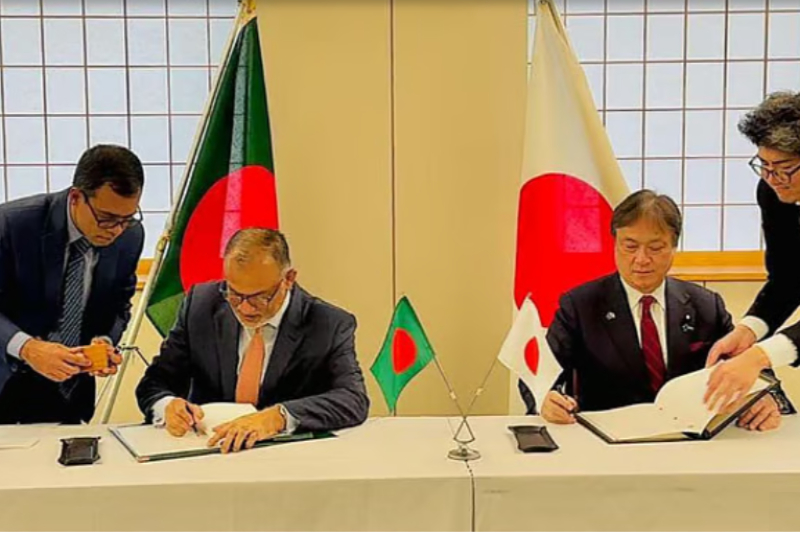
February 7, 2026: Bangladesh has signed its first-ever Economic Partnership Agreement (EPA) with Japan, securing duty-free access for more than 7,300 Bangladeshi products, including ready-made garments, to the Japanese market.
The agreement was concluded just five days ahead of Bangladesh’s national election, marking a major milestone in the country’s trade diplomacy.
The agreement was signed in Tokyo on Friday by Bangladesh’s Commerce Adviser Sheikh Bashir Uddin and Japan’s State Minister for Foreign Affairs Hori Iwao. Senior officials from both countries, including Commerce Secretary Mahbubur Rahman, Bangladesh’s Ambassador to Japan Md Daud Ali, and Japan’s Ambassador to Bangladesh Saida Shinichi, were present at the signing ceremony.
Seven Rounds of Negotiations Led to Historic Deal
According to an official statement, the EPA is the outcome of seven rounds of negotiations held in Dhaka and Tokyo, covering trade in goods and services, investment, and broader economic cooperation.
These discussions laid the foundation for a comprehensive framework aimed at strengthening bilateral trade ties.
Duty-Free Benefits for Thousands of Bangladeshi Products
Under the EPA, approximately 7,379 Bangladeshi products will enjoy 100 percent duty-free access to the Japanese market. In return, Bangladesh has agreed to gradually open its market to Japanese exports, with 1,039 Japanese products set to receive duty-free or preferential tariff treatment over time.
A key feature of the agreement is the inclusion of the “single-stage transformation” rule for the garment sector. This provision allows Bangladeshi apparel manufacturers to export garments to Japan without complex conditions related to the origin of raw materials, significantly simplifying compliance requirements.
New Opportunities for Bangladeshi Professionals
Beyond goods trade, the EPA also creates new pathways for Bangladeshi professionals in Japan. The agreement opens access to around 120 service sub-sectors across 16 broad categories, including information technology, engineering, education, caregiving, and nursing. These provisions are expected to expand employment opportunities for skilled Bangladeshi workers in the Japanese market.
Bangladesh, in turn, has committed to opening 98 sub-sectors under 12 service categories for Japanese participation.
Boost to Investment and Industrial Growth
Officials expect the agreement to encourage increased Japanese foreign direct investment (FDI) in sectors such as manufacturing, infrastructure, energy, and logistics. Access to advanced Japanese technology and capital is anticipated to enhance product quality, improve industrial efficiency, and strengthen Bangladesh’s global competitiveness.
The EPA is also expected to support the growth of small and medium enterprises (SMEs) and contribute to workforce skill development, promoting inclusive economic growth and broader socio-economic progress.
A Strategic Step in Bangladesh’s Trade Policy
Speaking at the signing ceremony, Commerce Adviser Sheikh Bashir Uddin described the EPA as more than a trade agreement, calling it a reflection of the longstanding friendship and mutual trust between Bangladesh and Japan.
He expressed hope that effective implementation of the agreement would usher in a new era of shared prosperity.
Except for a preferential trade agreement (PTA) with Bhutan, Bangladesh has not previously signed any bilateral economic or trade agreement.
The Japan EPA therefore marks the beginning of a new phase in Bangladesh’s engagement with global trade frameworks.
Negotiations Spanned Political Transitions
The initiative for the Bangladesh–Japan EPA was originally launched during the tenure of the previous government, with a joint study group formed to assess feasibility.
A report published in December 2023 recommended negotiations across 17 key sectors, forming the basis for formal talks.
Following an official announcement in March 2024, negotiations began in Dhaka in May. Although discussions paused temporarily after political changes in August 2024, the current interim government revived talks in November, setting a one-year target for completion.
Subsequently, seven negotiation rounds were held alternately in Dhaka and Tokyo, culminating in the final agreement. The Ministry of Commerce formally announced the signing in December last year.