Bangladesh Budget FY2026-27: Cigarettes, Fuel Cars, Cashews, and Bicycles to Cost More; Rice, Spices, Laptops, and Gold Jewelry Set to Get Cheaper
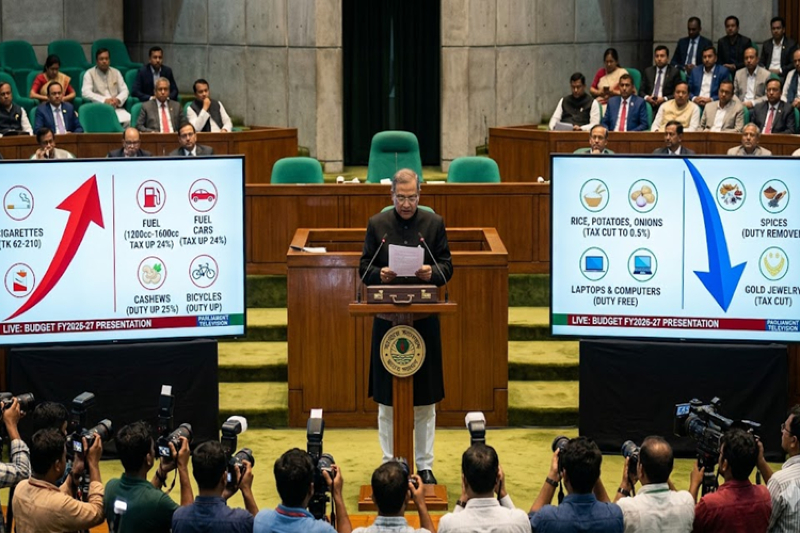
DHAKA — Finance Minister Amir Khasru Mahmud Chowdhury on Thursday placed a Tk 9.38 trillion national budget for the fiscal year 2026-27 in parliament.
Marking the first budget of the BNP government’s current tenure, the fiscal blueprint introduces broad-spectrum modifications to custom duties, supplementary taxes, and assessable import valuations.
The government’s strategy centers on two main goals: curbing environmental hazards and shielding domestic industries by penalizing dependency on imports, while simultaneously offering sweeping tax relief on IT hardware, life-saving medical supplies, and daily groceries to ease inflationary pressures on citizens.
The Hit to the Wallet: What is Getting Pricey?
To discourage harmful habits, reduce fossil-fuel reliance, and give local manufacturers a competitive edge, the budget aggressively hikes duties on several items.
Smoking and Driving
Cigarette Price Tiers: Smoking will become costlier as minimum retail prices for a 10-stick pack have been readjusted across four distinct brackets: Tk 62 for low, Tk 92 for medium, Tk 160 for high, and Tk 210 for the premium segment. Furthermore, the supplementary duty on nicotine pouches and granules has been elevated from 300% to 350%.
Fossil-Fuel Vehicles: To disincentivize carbon emissions, the total tax incidence on imported mid-range internal combustion engine (ICE) cars with capacities ranging from 1,200cc to 1,600cc climbs from 132.36% to around 156%.
Imported Groceries and Luxury Edibles
Cashew Nuts: In a bid to cultivate a robust domestic cashew farming sector, import duties on both raw and processed versions have been scaled up to a uniform 25% (a sharp jump from the previous 1% and 5% rates). However, to support local processors, their raw cashew imports will carry a lower 15% duty.
Seafood and Honey: Imported pangasius fish fillets will now face a new 20% supplementary duty to insulate domestic fish processing factories. Additionally, the minimum customs assessment value for imported natural honey has been raised by $2 to $7 per unit, ensuring retail price hikes.
Betel Nuts and Treats: The minimum customs value for betel nut imports has been bumped up by $0.25 per unit. Upward revisions have also been applied to the customs valuation of imported coffee, sugar confectioneries, and ready-to-eat packaged foods.
Construction, Appliances, and Makeup
Home Goods and Appliances: To encourage import substitution, a fresh 20% supplementary duty has been placed on all imported household washing machines. Imported microwave ovens, toys, foam items, tiles, and sanitary basins will also see price climbs due to altered tariff structures.
Bicycles: Sourcing components for domestic bicycle assembly will get tougher as the import duty on freewheel parts goes up from 15% to 25%, compounded by an additional 5% supplementary duty.
Steel Rods and LPG Cylinders: The construction sector faces pressure as VAT has been increased on vital raw ingredients used in manufacturing steel rods. At the consumer level, imported composite liquefied petroleum gas (LPG) cylinders will now attract VAT right at the import stage.
Cosmetics: Expect to pay more for imported lip liners and lip gels due to a higher reassessment of customs import values.
Consumer Relief: What is Getting Cheaper?
To counter years of unyielding living costs, the government has enacted deep tax cuts, slashed source taxes, and entirely rolled back regulatory barriers on key sectors.
Kitchen Staples and Nutrition
60 Essential Goods: In a sweeping bid to offer direct household relief, the source tax rate on 60 foundational commodities—including rice, paddy, wheat, potatoes, onions, garlic, ginger, salt, sugar, fish, poultry, livestock, edible oils, and seeds—has been compressed down to a flat 0.5% from original rates that hovered between 1% and 5%.
Spices and Dates: Cooking essentials will see a price drop as the 5% regulatory duty on spices like cumin, cinnamon, cardamom, cloves, coriander, and black pepper has been entirely revoked. Similarly, the 5% regulatory duty on imported dates has been eliminated.
Infant Nutrition: The import tariff levied on industrial raw ingredients for domestic baby food production has been scaled down from 15% to 10%.
The Digital Push and Clean Energy
Computers and IT Hardware: In a monumental boost to the country's technology goals, the budget entirely abolishes all forms of import duties, regulatory duties, supplementary duties, and VAT on laptops, desktop computers, monitors, servers, and printers.
Electric Cars (EVs): Eco-friendly transportation is receiving an unprecedented push. The total tax burden for electric vehicles valued under $25,000 has dropped from 93% to 64%, while those capped at $50,000 see a reduction to 80%. Fiscal breaks have also been expanded to plug-in hybrids (PHEVs), EV battery charging infrastructures, and BRTA registration fees.
Solar Power: Clean energy components and Point-of-Sale (POS) machine imports will see favorable, low-tariff entry terms.
Medical Expenses and Lifestyle
Kidney Care: In a major humanitarian relief measure, the 15% VAT and 5% advance income tax on imported dialysis filters have been completely removed. This policy adjustment is expected to slash the cost of individual dialysis procedures by up to Tk 800 for kidney patients.
Pharmaceuticals: The government has introduced widespread duty concessions on raw pharmaceutical ingredients, including a dedicated zero-tariff window for nine specific raw chemicals critical to producing cancer medications.
Gold and Jewelry: Trading and purchasing gold will experience a major cost drop as the source tax on gold supplies plunges from 5% to 0.5%. This reduces the cumulative VAT burden down to Tk 2,500 per bhori on gold valued at Tk 250,000 (previously a steep Tk 12,500).
Arts and Entertainment: The 5% regulatory duty on imported guitars, pianos, violins, and other musical instruments has been struck down completely. Cinema equipment is also getting cheaper, with import duties on cinematographic cameras, projectors, and their replacement parts dropping from 15% to 5%.
Skincare: While lip makeup gets costlier, everyday imported items like face washes and lipsticks are projected to get cheaper due to strategic custom valuation rollbacks.