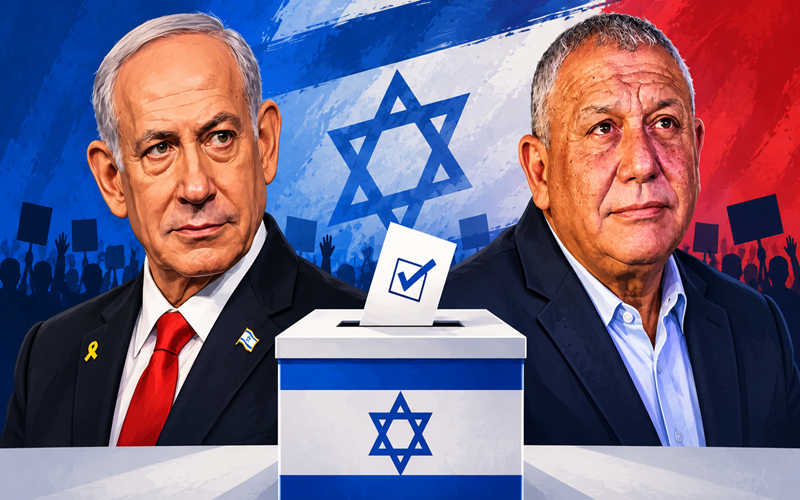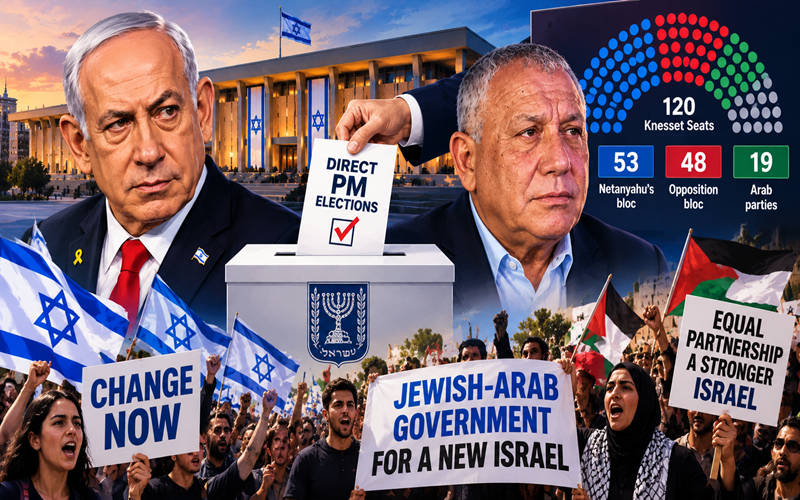
JERUSALEM, October 31, 2026: Israel's opposition parties are considering a proposal to introduce direct elections for prime minister as the country struggles to overcome a parliamentary deadlock following Tuesday's general election, while demonstrations are being organized to demand a government supported by both Jewish and Arab political parties.
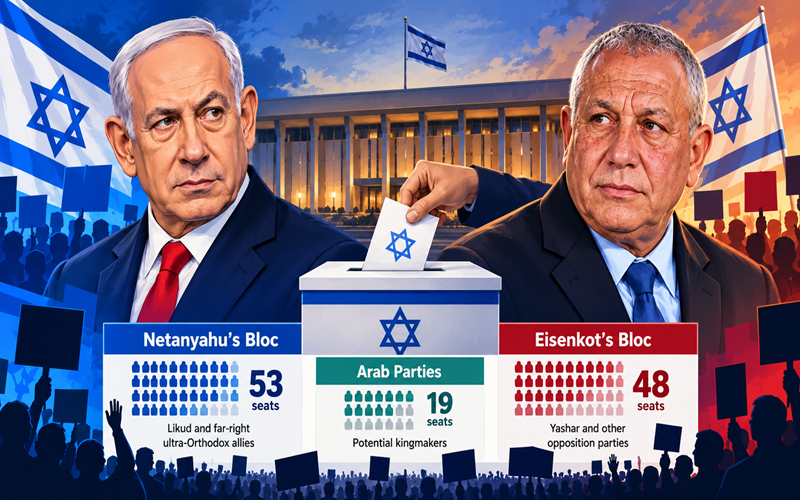
The proposal has emerged after the election left Prime Minister Benjamin Netanyahu's right-wing alliance with 53 seats in the 120-member Knesset, short of the 61 required to form a majority government.
The Jewish-led opposition parties secured 48 seats, while Arab-led parties won 19, bringing the total number of lawmakers outside Netanyahu's alliance to 67.
Despite their combined parliamentary strength, disagreements over cooperation with Arab parties have prevented the opposition from establishing a clear path towards forming an alternative administration.
Against this backdrop, senior opposition figures are reportedly exploring whether Israel could return to a system in which voters elect the prime minister directly, without requiring another parliamentary election.
Opposition Considers Changing Electoral System
According to reports in Israeli media, opposition leaders are discussing legislation that would allow a separate election for prime minister while retaining the newly elected Knesset.
The proposal is being examined as an alternative to prolonged coalition negotiations or another general election.
Israeli newspaper Maariv, citing political commentators Ben Caspit and Michael Hauser Tov, reported that senior opposition figures were considering restoring the direct-election mechanism previously used in Israel.
Under the proposed arrangement, voters would choose the prime minister separately from the parliamentary composition, potentially allowing a candidate to seek to lead a minority administration.
However, such a change would face substantial legal and political obstacles.
Israel's Basic Law: The Government currently requires a prospective administration to obtain the confidence of the Knesset before taking office.
Introducing a direct prime ministerial election would therefore require legislative amendments supported by at least 61 lawmakers.
The discussions remain preliminary, and there is no indication that the proposal has secured the parliamentary support necessary for implementation.
Netanyahu's Earlier Proposal Returns to Political Debate
The latest initiative has attracted attention because Netanyahu himself supported a similar proposal during the political deadlock following Israel's March 2021 election.
At that time, his Likud party emerged as the largest parliamentary faction, but he struggled to assemble a governing majority.
A proposal for direct prime ministerial elections was subsequently advanced as a possible solution.
According to Israeli media reports, opposition figures are now referring to the idea as the Netanyahu 2021 direct-election model.
The renewed discussion reflects the difficulty facing both major political camps after the latest election.
Although Netanyahu's alliance holds more seats than the Jewish-led opposition parties, it remains eight seats short of a majority.
The opposition, meanwhile, could theoretically command the support of 67 lawmakers if the Jewish-led parties and Arab factions cooperated.
However, several opposition leaders have previously ruled out relying on Arab parties to establish a government.
These conflicting political commitments have made coalition negotiations particularly complicated.
Proposal to Limit Prime Minister's Tenure
Alongside discussions about direct elections, proposals to introduce limits on the prime minister's tenure have also resurfaced.
Political commentator Ben Caspit raised the possibility of legislation restricting a prime minister to two terms or a maximum of eight years in office.
Such legislation could potentially affect Netanyahu's political future, depending on its wording and whether previous periods in office were counted.
However, any attempt to introduce term limits would face legal and political questions, including whether the restrictions could apply retrospectively.
Caspit also recalled Netanyahu's earlier public support for limiting prime ministerial tenure.
During a 1997 television interview with Dan Shilon, Netanyahu expressed support for a two-term limit, arguing that a prime minister should have sufficient time to accomplish major objectives without remaining in office indefinitely.
The renewed debate comes as opposition politicians consider different mechanisms for breaking the parliamentary stalemate.
No agreement has been announced on either direct elections or term-limit legislation.
Demonstrations Planned in Support of Jewish-Arab Government
While political leaders explore legislative alternatives, civil society organizations are preparing demonstrations demanding cooperation between Jewish and Arab parties.
The Jewish-Arab grassroots movement Standing Together has announced rallies across Israel on Saturday evening in support of a government representing the parliamentary majority outside Netanyahu's alliance.
Demonstrations are scheduled for 7:30 p.m. at Habima Square in Tel Aviv and Paris Square in Jerusalem.
Additional gatherings are planned in Beersheba, Haifa and Tayibe.
Organizers argue that the election result provides an opportunity to replace Netanyahu's government through cooperation between Jewish and Arab political representatives.
They maintain that the 67 lawmakers elected outside the governing alliance should recognize their combined parliamentary strength and work towards establishing a new administration.
The movement has also called for equal political participation by Arab citizens, arguing that their votes should carry the same weight in government formation as those cast by Jewish citizens.
The demonstrations are expected to place additional pressure on opposition leaders who have resisted cooperation with Arab parties.
Arab Parties Hold Crucial Parliamentary Position
The strong performance of Arab-led political parties has become one of the defining developments of Israel's latest election.
Together, the Arab factions secured 19 seats, giving them substantial influence over the parliamentary balance.
Their representation means that the Jewish-led opposition cannot achieve a majority without additional support.
The result has intensified debate over whether opposition parties should reconsider their previous commitments against forming or supporting a government with Arab participation.
Supporters of cooperation argue that the election has created a parliamentary opportunity to replace Netanyahu through a broader political alliance.
Opponents maintain that significant ideological differences, particularly concerning national identity and security policy, make such an arrangement difficult.
These disagreements have prevented the opposition from converting its numerical advantage into a workable coalition.
The possibility of a minority government supported externally by Arab parties has also been discussed, although it remains politically contentious.
Netanyahu's Bloc Remains Short of Majority
Netanyahu's political alliance includes Likud, far-right factions and ultra-Orthodox Jewish parties.
Although the alliance emerged with 53 parliamentary seats, it lacks the numbers needed to establish a majority government without securing additional support.
The opposition's 48 Jewish-led seats, combined with the 19 seats held by Arab parties, leave Netanyahu facing a parliamentary majority outside his existing alliance.
However, that numerical balance does not automatically translate into a united opposition government.
Political differences among the parties, together with commitments made during the election campaign, have created obstacles to forming a coalition.
The situation has renewed concerns about another period of political instability.
Israel has experienced repeated elections and difficult coalition negotiations in recent years, with disagreements among political factions frequently complicating government formation.
Legal Challenges Could Complicate Direct Election Plan
Even if opposition leaders agree to pursue direct prime ministerial elections, changing the existing system would not be straightforward.
The current legal framework requires parliamentary confidence for a government to assume office.
A new direct-election arrangement would need to address the relationship between the elected prime minister and the Knesset, particularly if the prime minister did not command a parliamentary majority.
It would also require lawmakers to agree on the electoral procedures and the legal authority of a government formed under such a system.
Any amendments to the Basic Law would require sufficient parliamentary backing.
Consequently, the direct-election proposal cannot be implemented solely through an agreement among opposition leaders.
It would require legislative action in a parliament already divided over the country's future leadership.
Political Uncertainty Continues
The competing proposals underline the difficulty of resolving Israel's post-election political deadlock.
Netanyahu's alliance remains the largest organized parliamentary bloc but lacks a majority, while the parties opposed to him are divided over whether to cooperate with Arab representatives.
The prospect of direct prime ministerial elections has introduced another option into the political debate, although its legal feasibility and parliamentary support remain uncertain.
At the same time, planned demonstrations are expected to intensify public pressure on opposition leaders to explore a Jewish-Arab governing partnership.
The coming political negotiations will determine whether the rival parties can reach an agreement under the existing parliamentary system, pursue legislative changes or eventually face another election.
For now, Israel's election has produced a parliament in which the balance of seats is clear, but the route to forming a stable government remains unresolved.