
US Presses Iran to Accept Defeat as Tehran Vows to Continue Fighting
The Middle East stands at a critical juncture as the military confrontation between the United States, Israel, and Iran enters a volatile new phase.
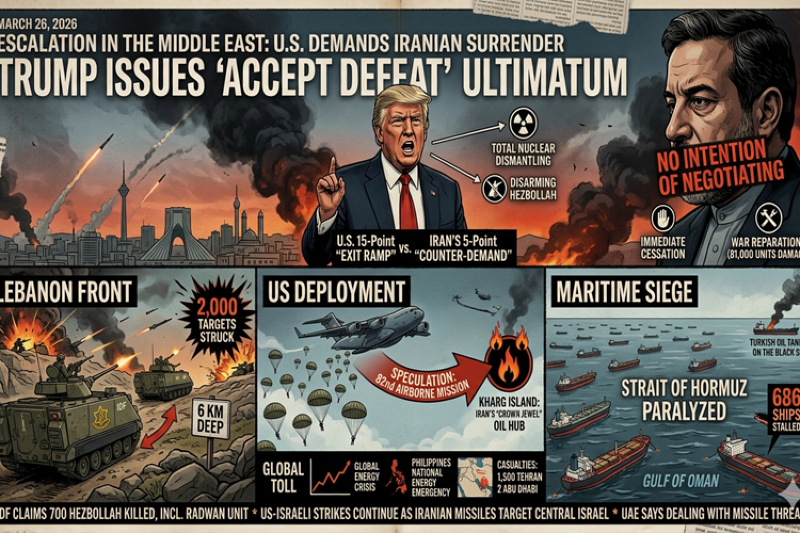
On March 26, 2026, the White House issued a stark ultimatum to Tehran, demanding the Islamic Republic "accept defeat" or face a military campaign of unprecedented scale.
Despite the intensifying pressure, Iranian leadership has officially rebuffed calls for dialogue, pledging to maintain its retaliatory strikes against Israel and regional targets.
A Multi-Front Battlefield
The conflict, which has now entered its third week, continues to expand geographically. In Southern Lebanon, the Israeli Defense Forces (IDF) have deepened their ground incursion, advancing up to six kilometers into Lebanese territory.
Israeli military spokespeople confirmed that operations are focused on neutralizing the Hezbollah "Radwan" units, claiming to have struck over 2,000 targets and killed approximately 700 fighters.
Simultaneously, the war has spilled into the Persian Gulf and the Black Sea. A Turkish-operated crude oil tanker carrying one million barrels of oil was reportedly struck by a drone in the Black Sea, though no casualties were reported. In the Gulf, the United Arab Emirates reported intercepting multiple missile threats, while civilian casualties were confirmed in Abu Dhabi due to falling debris.
US Paratroopers Deploy for Possible Kharg Island Assault
MARCH 26, 2026 — The military confrontation in the Middle East has reached a perilous inflection point. The United States has issued a definitive demand for Iran’s surrender, backed by the mobilization of elite rapid-response forces, while Tehran has formally rejected a 15-point U.S. peace plan, signaling an intensification of the multi-front war.
The Diplomatic Standoff: Contrasting Proposals
The core of the current deadlock lies in two irreconcilable frameworks for ending the hostilities. While President Trump claims the Iranian leadership is "afraid" to admit they are at the table, the official rhetoric from Tehran remains defiant.
| Feature | U.S. 15-Point "Exit Ramp" | Iran’s 5-Point Counter-Demand |
|---|---|---|
| Core Requirement | Total dismantling of nuclear infrastructure. | Immediate cessation of "all-front" hostilities. |
| Regional Proxy Status | Permanent disarmament of Hezbollah and Houthis. | Withdrawal of U.S. forces from the Middle East. |
| Economic Terms | Re-entry into global markets under U.S. oversight. | Payment of reparations for 81,000 destroyed units. |
| Strategic Goal | "Managed transition" of the Iranian regime. | Sovereignty and recognition of "resistance" wins. |
Military Escalation: The Push for a "Clear Winner"
Analysts suggest the conflict has shifted from a limited exchange to a search for a decisive psychological victory.
US Deployment: The 82nd Airborne Division has been mobilized for rapid deployment. Speculation is mounting in Washington that these troops may target Kharg Island, the "crown jewel" of Iran’s oil export economy, to force a total financial collapse of the regime.
The Lebanon Front: The Israeli military has advanced up to six kilometers into Lebanese territory, claiming to have hit 2,000 Hezbollah targets. In response, Hezbollah has intensified its use of anti-tank missiles, claiming hits on seven Israeli tanks in the Marjayoun district.
The Maritime Siege: The Strait of Hormuz remains effectively paralyzed. Currently, 686 ships are stalled in the region, with 400 holding positions in the Gulf of Oman, hesitant to commit to long-haul rerouting despite the ongoing missile threats.
The Human and Global Toll
The conflict’s ripples are being felt far beyond the borders of the Middle East.
Casualties: In Tehran alone, air strikes have reportedly killed 1,500 people. In the UAE, falling missile debris resulted in two fatalities in Abu Dhabi.
Energy Crisis: The Philippines has declared a national energy emergency, suspending spot sales of electricity to combat the extreme price volatility caused by the disruption of Gulf oil.
While the U.S. administration insists it is "very close" to meeting its objectives, the Iranian Foreign Ministry's refusal to negotiate suggests a protracted war of attrition. As Elijah Magnier, a regional specialist, noted, the conflict currently lacks a "clear loser," a void both sides seem determined to fill through further escalation.