
Trump Demands ‘Unconditional Surrender’ as War With Iran Intensifies
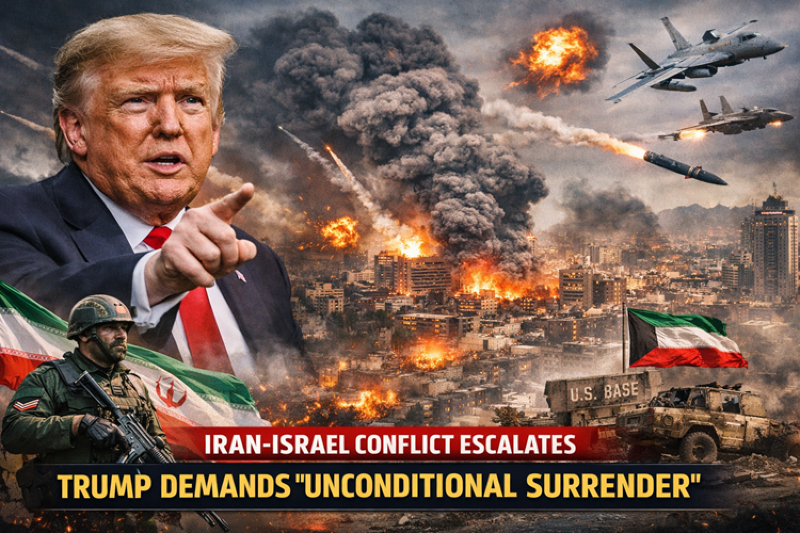
The conflict between the United States, Israel and Iran intensified on Friday as fighting entered its seventh day, with US President Donald Trump demanding Iran’s “unconditional surrender” while missile strikes, air raids and drone attacks spread across multiple countries in the Middle East.
Trump made the statement on social media, saying there would be no negotiations with Iran unless it accepts unconditional surrender. He also suggested that new Iranian leadership acceptable to Washington could pave the way for reconstruction efforts supported by the United States and its allies.
Massive Strikes Across Iran
Explosions were reported in several parts of Iran throughout the day as Israeli and US-backed attacks targeted infrastructure and strategic sites.
The Israeli military said it had launched a new wave of large-scale air strikes on Tehran and the central city of Isfahan, describing the operation as the 15th round of air raids since the war began. Israeli forces also claimed they had struck an underground bunker in Tehran believed to have been used by Iran’s leadership.
Iranian officials reported that three areas in the holy city of Qom were also hit by strikes shortly after Israeli authorities warned civilians to evacuate parts of the city’s industrial zone ahead of military operations.
Reports from Iranian media indicated that residential buildings in Tehran had also been damaged during the bombardment.
Heavy Casualties and Damage
According to Iran’s Health Ministry spokesperson Hossein Kermanpour, the ongoing attacks have caused significant casualties and destruction.
More than 2,000 people are currently receiving treatment in hospitals, and over 625 surgical operations have been performed since the start of the conflict. Among those killed are 198 women, while several healthcare workers have also died.
Authorities said 11 hospitals, eight emergency medical centres and 12 ambulances have been damaged in the attacks.
The youngest injured victim is a four-month-old baby girl, while the oldest patient receiving treatment is a 94-year-old woman.
Separate reports said at least 20 people were killed in the southern Iranian city of Shiraz, including civilians.
Iran Launches Regional Retaliation
Iran responded with a series of missile and drone attacks across the region.
Iranian state television reported that missiles were fired at a US military base in Kuwait, while Iranian forces also targeted positions of Kurdish armed opposition groups in the Kurdistan region of northern Iraq.
Iran’s Islamic Revolutionary Guard Corps (IRGC) said its latest generation of missiles struck American bases in Gulf countries and Israeli targets including Ben Gurion Airport, Tel Aviv and Haifa.
Iran also claimed to have attacked a US-owned oil tanker off the coast of Kuwait, setting the vessel on fire. Another ship was reportedly hit by a drone in the Strait of Hormuz, a key global oil shipping route.
Gulf Countries Intercept Missiles
Several Gulf nations reported intercepting incoming Iranian missiles and drones.
The United Arab Emirates said its air defence systems shot down nine ballistic missiles and 109 drones in a single day, bringing the total number intercepted since the war began to 190 ballistic missiles and more than 1,100 drones.
Meanwhile, Kuwait confirmed its military was actively responding to missile and drone attacks that had entered its airspace.
Authorities in Qatar raised the national security threat level and urged residents to remain indoors due to the risk of further attacks.
Fighting Spreads to Lebanon
The conflict has also expanded into Lebanon. Israeli forces launched more than 15 air strikes on Beirut’s southern suburbs, an area associated with the militant group Hezbollah.
Additional strikes hit towns in southern Lebanon, including the coastal city of Sidon, where Lebanese officials said five people were killed and seven others wounded.
Lebanon’s prime minister warned that the country is facing a “dangerous moment” and appealed for international support, saying the situation could develop into a humanitarian disaster as thousands of people flee affected areas.
International Concern Over Escalation
European leaders expressed growing concern about the widening conflict.
German Chancellor Friedrich Merz warned that prolonging the war would threaten regional stability and could harm Europe’s energy security. He also cautioned that instability in Iran might trigger large-scale migration toward Europe.
Energy experts also warned that the fighting could disrupt global oil markets. Qatar’s Energy Minister Saad al-Kaabi said the conflict could potentially “bring down the economies of the world” if Gulf energy producers are forced to halt production.
Iran Calls for International Mediation
Iranian President Masoud Pezeshkian said Tehran remains open to diplomatic mediation but insisted that negotiations must address what he described as the actions of those who “ignited this conflict”.
He stated that Iran would continue to defend its sovereignty and national dignity against foreign attacks.
Regional Crisis Deepens
As missile exchanges and air strikes continue across the Middle East, the war is increasingly drawing in neighbouring countries and threatening vital global shipping routes and energy infrastructure.
With attacks reported in Iran, Lebanon, Iraq and the Gulf region, analysts warn that the conflict could evolve into a much wider regional war unless diplomatic efforts succeed in halting the fighting.