
Special Report: IWD 2026: Gender Equality as a Strategic Driver of Global Development
By Anonna Reza
Dhaka | March 8, 2026
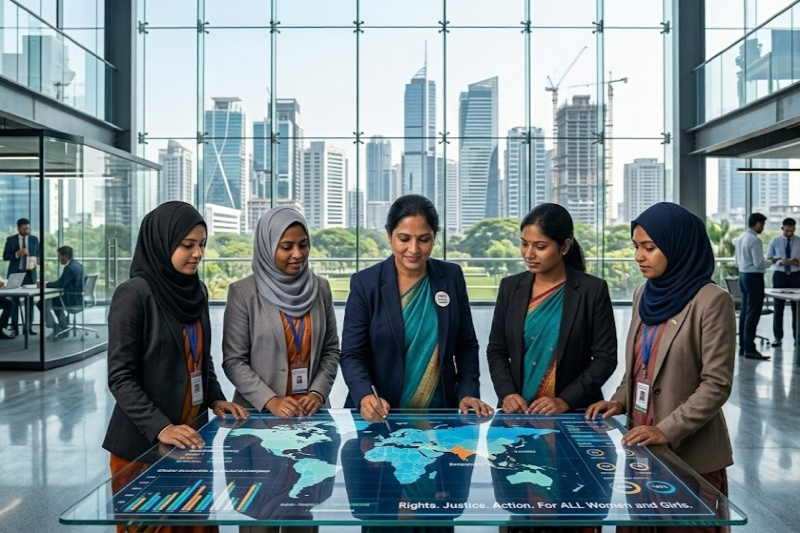
On this International Women’s Day 2026, the global conversation on gender equality has entered a new phase. Under the United Nations theme “Rights. Justice. Action.
For ALL Women and Girls,” the world is increasingly moving beyond symbolic commitments toward measurable justice, structural reforms, and inclusive governance.
Yet despite decades of progress, gender inequality remains deeply embedded in economic and legal systems.
According to the World Bank Women, Business and the Law report, women worldwide enjoy only about 64% of the legal rights available to men, when workplace protections, mobility rights, childcare access, and safety laws are fully measured.
From an economic perspective, gender inequality also represents a major lost opportunity. Research cited by the International Monetary Fund and the World Economic Forum suggests that closing gender gaps in labor markets and entrepreneurship could increase global GDP by more than 20%, making gender equality one of the most powerful drivers of long-term economic growth.
As climate change intensifies and digital technologies transform labor markets, the role of women is evolving from being participants in development to strategic leaders shaping global resilience and innovation.
Bangladesh: The Vanguard of the “Bottom-Up” Revolution
Bangladesh is frequently highlighted as a success story for women’s economic participation in the Global South. Women have played a central role in the country’s development—especially through export-oriented manufacturing, rural entrepreneurship, and grassroots climate adaptation.
However, significant opportunities remain unrealized. According to analysis cited by the International Monetary Fund, closing the gender participation gap could increase Bangladesh’s GDP by nearly 40%—demonstrating the scale of economic potential tied to women’s empowerment.
The country’s development trajectory has also been shaped by women’s resilience in climate-vulnerable environments. From floating schools in flood-prone regions to coastal fishery cooperatives led by women, local initiatives have become powerful examples of community-driven climate adaptation.
The Asian Development Bank has emphasized that women’s leadership in climate adaptation projects significantly improves community resilience and disaster preparedness, particularly in South and Southeast Asia.
The Digital and AI Gap
Yet the next challenge for Bangladesh lies in the digital economy. As artificial intelligence and automation reshape global industries, women remain underrepresented in STEM fields and emerging technology sectors.
According to global data compiled by the World Economic Forum, women represent only around 30% of the global technology workforce and less than 25% of AI professionals.
Without targeted investment in digital education and leadership opportunities, developing economies risk creating a new form of inequality—the gender digital divide.
USA and UK: Negotiating the Care Economy
In advanced economies such as the United States and the United Kingdom, the challenge is no longer access to employment but the structure of work itself.
The unequal distribution of unpaid care work continues to limit women’s economic participation. According to UN Women, women perform approximately 75% of unpaid care work globally, spending significantly more time than men on childcare, eldercare, and household responsibilities.
This imbalance has measurable economic consequences. Studies from the World Bank show that unpaid care responsibilities are one of the largest structural barriers preventing women from entering or remaining in the workforce.
Innovation and the Gender Funding Gap
Despite these barriers, Western economies are seeing rapid growth in women-led innovation—particularly in climate technology and sustainability startups.
However, structural financing barriers persist. According to entrepreneurship data highlighted by the World Economic Forum, less than 3% of global venture capital funding goes to female founders, reflecting persistent bias within investment ecosystems.
The Rise of “Returnship” Programs
To address career interruptions caused by caregiving, companies across the US and UK are expanding returnship programs, enabling professionals—particularly women—to re-enter the workforce without long-term career penalties.
These initiatives reflect a growing recognition that inclusive labor systems are essential for sustaining economic growth in aging societies.
The Asian Horizon: A Continent in Transition
Across Asia, women are increasingly becoming drivers of economic growth through entrepreneurship, digital commerce, and small-business innovation
However, structural barriers remain significant—particularly in political representation and economic policymaking
According to regional development assessments by the Asian Development Bank, women across Asia and the Pacific remain underrepresented in decision-making institutions, despite their significant contributions to local economies and climate resilience.
Overcoming the “Outside the Room” Barrier
Many women across the region remain outside the rooms where critical economic and climate decisions are made.
Increasing women’s participation in governance is not only a matter of fairness—it improves policy outcomes. Research from the Inter-American Development Bank shows that greater female representation in economic decision-making leads to more inclusive and socially balanced policy outcomes, particularly in areas such as education, healthcare, and poverty reduction.
Southeast Asia’s Entrepreneurial Momentum
Countries like Indonesia and Vietnam are witnessing a surge in women-led small and medium enterprises. These businesses are becoming key drivers of middle-class growth
Development economists consistently find that when women control financial resources, household investments in education, nutrition, and health increase, creating long-term social and economic benefits.
The 2026 Mandate: From Resilience to Justice
For decades, women around the world have been celebrated for their resilience—navigating economic crises, climate disasters, and structural inequalities.
But resilience should not be the benchmark for equality.
The global mandate for 2026 is to transition from resilience-based narratives to justice-driven policy frameworks.
Three priorities stand out:
According to the World Bank, women globally still hold only about 64% of the legal rights of men, highlighting the need for stronger legal protections and enforcement
As AI transforms global labor markets, women must become creators of technology—not casualties of automation. Expanding female participation in STEM education, AI research, and digital entrepreneurship will be crucial.
The UN Women emphasizes that women are often the first responders and most innovative problem-solvers in climate-affected communities. Elevating them to leadership positions in environmental governance will strengthen global climate strategies.
Policy Recommendations: Advancing Women as Strategic Leaders in Global Policy
1. Strengthen Legal and Institutional Frameworks
Governments should prioritize reforms that close the persistent gender legal gap identified by the World Bank.
Actions:
Reform discriminatory laws affecting property ownership, inheritance, employment rights, and financial access.
Strengthen enforcement mechanisms for workplace equality and anti-discrimination policies.
Establish gender-responsive public institutions to monitor and implement legal protections.
Expected Outcome:
Improved legal equality can increase women’s economic participation and accelerate national economic growth.
2. Invest in Women’s Digital and AI Skills
As digital transformation reshapes global labor markets, closing the gender gap in technology is critical.
Actions:
Expand scholarships and STEM training programs targeting women and girls.
Develop public-private partnerships with technology companies to train women in AI, data science, and cybersecurity.
Integrate digital literacy into national education systems from early stages.
According to the World Economic Forum, women remain significantly underrepresented in AI and technology sectors, making targeted interventions essential.
Expected Outcome:
Increased participation of women in digital industries and future-ready labor markets.
3. Recognize and Reform the Care Economy
Unequal unpaid care work continues to limit women’s career opportunities.
Actions:
Expand affordable childcare services and eldercare support systems.
Introduce family-friendly workplace policies such as parental leave and flexible work arrangements.
Encourage corporate adoption of returnship programs to help women re-enter the workforce.
Research from UN Women highlights that women perform the majority of unpaid care work globally.
Expected Outcome:
Greater labor market participation and reduced gender employment gaps.
4. Promote Women’s Access to Finance and Entrepreneurship
Financial barriers remain a major constraint for women entrepreneurs.
Actions:
Expand gender-responsive financial programs through development banks.
Increase access to microfinance, credit facilities, and investment funds for women-led businesses.
Encourage venture capital funds to adopt gender-inclusive investment strategies.
Evidence from the World Economic Forum shows that female founders receive a very small share of venture capital funding globally.
Expected Outcome:
Stronger innovation ecosystems and increased economic productivity.
5. Integrate Women into Climate Governance and Environmental Leadership
Women play a crucial role in climate adaptation but remain underrepresented in environmental decision-making.
Actions:
Ensure women’s representation in national climate councils and environmental policy institutions.
Support women-led climate adaptation projects in vulnerable regions.
Expand climate financing programs that prioritize women’s participation.
The Asian Development Bank notes that women’s leadership improves community resilience and disaster preparedness.
Expected Outcome:
More effective and inclusive climate adaptation strategies.
6. Increase Women’s Participation in Economic and Political Decision-Making
Women remain underrepresented in policymaking institutions across many regions.
Actions:
Implement gender quotas or targets for political and corporate leadership.
Strengthen leadership development programs for women in public policy and governance.
Support regional cooperation initiatives to promote gender-inclusive policy frameworks.
Research from the Inter-American Development Bank indicates that greater female representation leads to more inclusive and socially balanced policies.
Expected Outcome:
Improved governance and more equitable development outcomes.
🌍 International Women’s Day 2026
Women as Strategic Leaders in Global Policy (Infographic Summary)
| 🌎 Theme | 📊 Key Statistics | 🌏 Regional Example | 📚 Source |
|---|---|---|---|
| ⚖️ Legal Equality Gap | Women globally have only 64% of the legal rights of men | Legal protections still unequal in many economies | World Bank |
| 💰 Economic Opportunity | Closing gender gaps could increase global GDP by 20%+ | Higher employment & entrepreneurship boost productivity | International Monetary Fund / World Economic Forum |
| 🇧🇩 Bangladesh: Bottom-Up Revolution | Female workforce participation about 42.7% | Women power garments, rural enterprises, and climate adaptation | IMF analysis |
| 📈 Bangladesh Growth Potential | Gender parity could raise GDP by nearly 40% | Major economic potential through women's employment | International Monetary Fund |
| 🌊 Climate Leadership | Women leading community adaptation projects | Floating schools & women-led coastal fisheries | Asian Development Bank |
| 💻 Digital & AI Gap | Women represent 30% of tech workforce and <25% of AI professionals | Risk of gender digital divide in emerging economies | World Economic Forum |
| 👩👧 Care Economy Challenge | Women perform 75% of unpaid care work globally | Limits career advancement in US, UK and beyond | UN Women |
| 💼 Entrepreneurship Funding Gap | <3% of venture capital goes to female founders | Barriers remain in innovation ecosystems | World Economic Forum |
| 🌏 Asia-Pacific Transition | Women underrepresented in policymaking institutions | Despite strong role in SMEs and digital commerce | Asian Development Bank |
| 📊 Policy Impact | Greater female representation improves education, health, and poverty policies | Evidence across developing economies | Inter-American Development Bank |
🎯 The 2026 Global Mandate
| Priority | Goal |
|---|---|
| ⚖️ Legal Equality | Close the global legal rights gap |
| 💻 Digital Agency | Increase women in STEM, AI, and tech leadership |
| 🌱 Climate Leadership | Empower women as climate innovators and policymakers |
Sources:
World Bank | UN Women | World Economic Forum
Conclusion
Achieving gender equality requires coordinated action across legal, economic, technological, and environmental domains.
By implementing targeted reforms and investing in women’s leadership, governments and international organizations can unlock significant economic potential while promoting more inclusive and sustainable development.
As the global community observes International Women’s Day 2026, the focus must move beyond symbolic recognition toward systemic change that positions women as strategic leaders in shaping the future of global policy.
Anonna Reza is an English journalist with a Postgraduate Diploma in Business Studies from the United Kingdom and an MBA from the American International University-Bangladesh (AIUB).