
Iran Vows Stronger Missile Strikes as Trump Sends Mixed Signals on War
Tensions in the Middle East continued to escalate on Tuesday as Iran pledged to deploy more powerful missiles, while US President Donald Trump delivered conflicting remarks about the future of the war.
The situation has intensified fears of a prolonged regional conflict involving several countries and armed groups.
Iran’s Islamic Revolutionary Guard Corps (IRGC) rejected US claims that its missile capabilities had been destroyed during recent attacks.
Officials said the country is now preparing to launch missiles in greater numbers, some carrying warheads weighing more than one tonne.
At the same time, Trump warned that the United States would respond “twenty times harder” if Iran attempts to block oil tankers passing through the Strait of Hormuz, a vital maritime route that carries roughly one-fifth of the world’s oil supply.
Confusion Over US War Strategy
Comments from Trump have created uncertainty about Washington’s plans. Earlier in the day, the US president suggested the war might end soon.
However, speaking later at a press conference in Florida, he indicated that fighting could continue for another week or longer and even left open the possibility of deploying ground troops.
Political observers in Washington, D.C. say the shifting tone has added to concerns about the financial and strategic costs of the conflict.
Air Strikes Shake Tehran
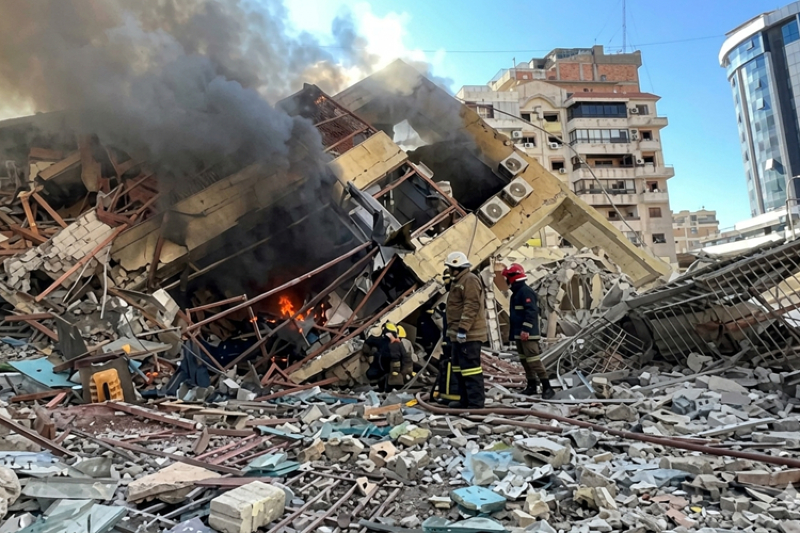
Meanwhile, residents in Tehran reported hearing multiple explosions overnight as a new wave of air strikes hit the Iranian capital. Local reports said at least 40 civilians were killed when blasts struck residential areas rather than military sites.
Emergency responders from the Iranian Red Crescent Society warned residents to avoid exposure to rainfall following the attacks, saying pollution from damaged oil facilities may have contaminated the air and rainwater. Power outages have also been reported in several parts of the city.
Hezbollah Launches Rocket Attacks
In neighbouring Lebanon, the armed group Hezbollah claimed it fired rockets at Israeli military positions near the border, including sites close to the town of Aitaroun. The group said additional rockets targeted Israeli troops and artillery positions in southern Lebanon.
Iran Rejects Ceasefire Pressure
Senior Iranian officials signalled little willingness to negotiate a ceasefire at this stage. Deputy Foreign Minister Kazem Gharibabadi said that while countries such as China, France, and Russia have made contact regarding de-escalation, Iran would only consider talks if the United States and Israel guarantee they will not launch further attacks.
“We believe we have the upper hand,” he said, arguing that the conflict has already caused disruption to global energy markets.
Diplomatic Site Targeted in Iraq
Separately, a drone strike hit the UAE Consulate in Erbil, located in **Iraqi Kurdistan. The attack caused damage to the building but no casualties were reported.
The Saudi Ministry of Foreign Affairs condemned the incident, calling repeated attacks on diplomatic facilities a violation of international law.
Iraq Reinforces Border With Iran
Amid fears that the war could spread further, Iraq has deployed additional troops along its border with Iran. Authorities say the move is intended to prevent Iranian Kurdish armed groups from using northern Iraq as a launching point for operations inside Iran.
Officials in Baghdad say the reinforcement also reflects commitments under a 2023 security agreement aimed at limiting cross-border militant activity.
Markets React to War Uncertainty
Global markets reacted sharply to developments in the conflict. Oil prices surged to nearly $120 per barrel before dropping below $90 after Trump suggested the war could end soon.
Stock markets across the Asia-Pacific region later rebounded, with major indexes in Japan, South Korea, Hong Kong, and Australia recording gains.
Despite the temporary market recovery, analysts warn that shipping disruptions in the Strait of Hormuz and continuing military exchanges could still trigger major economic shocks worldwide.