
Inside the Shadows: How CIA-Mossad Intelligence Led to the Strike on Khamenei
In the wake of the seismic shift in Middle Eastern power, new details have emerged regarding the surgical intelligence operation that led to the death of Iran’s Supreme Leader, Ayatollah Ali Khamenei.
Sources familiar with the mission reveal that a high-stakes "intelligence handshake" between the United States and Israel provided the window of opportunity for the fatal strike.
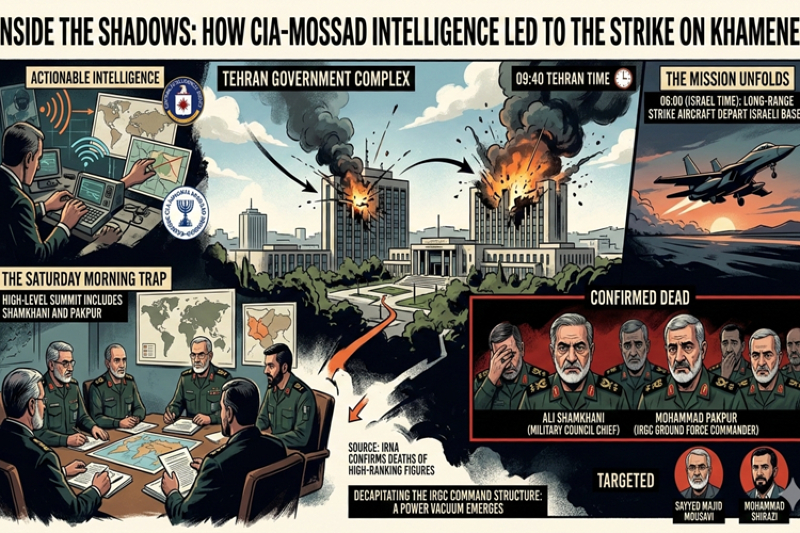
The Saturday Morning Trap
According to officials speaking on the condition of anonymity, the Central Intelligence Agency (CIA) had been meticulously tracking Khamenei’s movements and daily habits for months.
The breakthrough came when American signals and human intelligence confirmed a high-level summit scheduled for Saturday morning at a secure government complex in central Tehran.
The meeting was set to include the upper echelon of Iran's defense and security apparatus. Upon receiving this "actionable intelligence," military planners in Washington and Tel Aviv reportedly made a last-minute decision to scrap a planned night raid in favor of a daylight precision strike to ensure the "total decapitation" of the leadership.
Timeline of the Operation
The mission, characterized by "tactical surprise" despite Iran being on a high state of military alert, unfolded with clinical precision:
06:00 (Israel Time): A specialized wing of long-range strike aircraft departed from Israeli bases, equipped with high-precision, bunker-busting munitions.
09:40 (Tehran Time): After a flight of just over two hours, the missiles impacted the government complex.
The Target: While top security officials—including Rear Admiral Ali Shamkhani and Major General Mohammad Pakpur—were in one wing of the facility, Khamenei was located in an adjacent building. Both structures were devastated.
A Legacy of Surveillance
The success of the operation is being traced back to intelligence gathered during the "12-Day Conflict" of the previous year. During that period, U.S. and Israeli agencies reportedly mapped the communication protocols and emergency transit routes used by the Islamic Revolutionary Guard Corps (IRGC).
"This wasn't just a lucky shot," noted a former U.S. official. "It was the culmination of a deep-cover network that has been expanding since last June. We didn't just know where he was; we knew his schedule better than his own security detail did."
The Casualty List: Decapitating the IRGC
While the White House and the CIA have declined to comment officially, Iranian state media (IRNA) has begun confirming the deaths of several high-ranking figures. The losses represent a catastrophic blow to Iran’s command structure:
Confirmed Dead: Ali Shamkhani (Military Council Chief) and Mohammad Pakpur (IRGC Ground Force Commander).
Targeted: The list of attendees included IRGC Aerospace Force Commander Sayyed Majid Mousavi and Deputy Intelligence Minister Mohammad Shirazi.
While some reports suggest a few top intelligence officers managed to flee the complex seconds before impact, the core of Iran’s senior leadership has been effectively neutralized.
Strategic Implications
The strike proves that even with heightened security, the Iranian leadership's "inner sanctum" was compromised. The focus now turns to the Assembly of Experts as they scramble to fill a power vacuum that many analysts believe could lead to internal friction or a hardline military takeover by remaining IRGC elements.