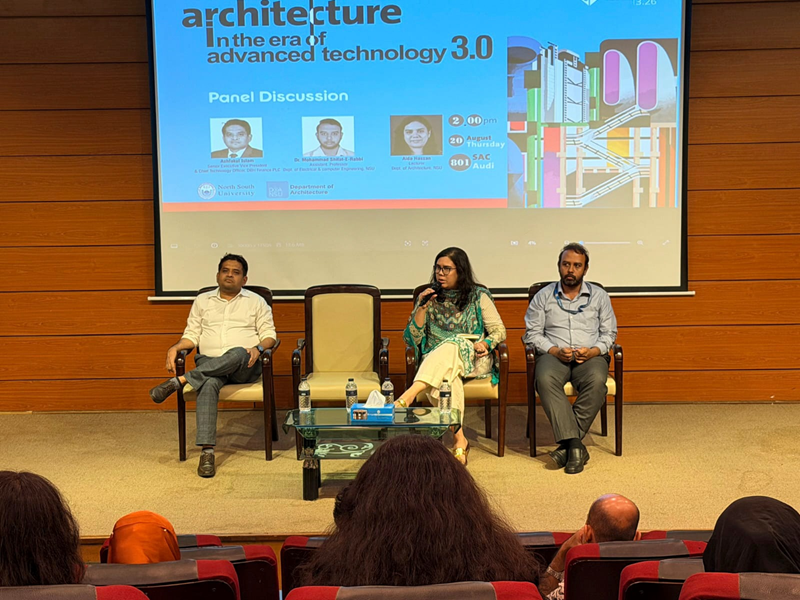
Dhaka- The Department of Architecture at North South University (NSU) organized the third panel discussion of the ‘Kathon Lecture Series’, titled “Architecture in the Era of Advanced Technology 3.0,” at Audi 801, NSU on Thursday (August 20, 2026).
The discussion focused on the growing role of Artificial Intelligence (AI) in architecture, including creativity, design, urban analysis, professional practice, ethics, and the future of the profession.
The session was moderated by Ar. Shahriar Iqbal Raj, Associate Professor and Chair of the Department of Architecture, NSU.
The panel featured Ashfakul Islam, Senior Executive Vice President and Chief Technology Officer, Delta Brac Housing Finance PLC; Dr. Mohammad Shifat-E-Rabbi, Assistant Professor, Department of Electrical and Computer Engineering, NSU; and Aida Hasan, Lecturer, Department of Architecture, NSU.
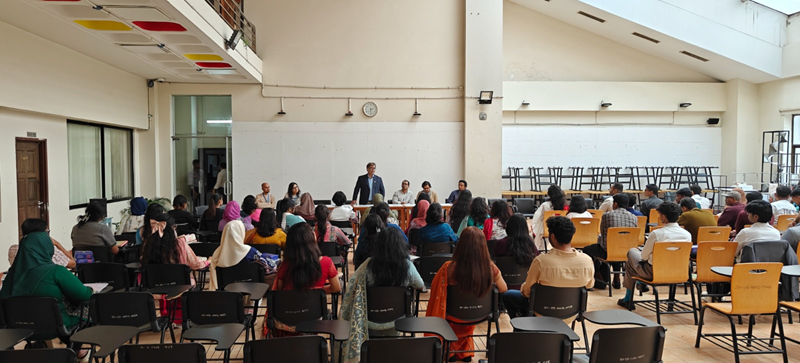
Faculty members and students of the Department of Architecture also attended the event.
The discussion explored whether AI-generated outputs can truly be considered creative.
Dr. Mohammad Shifat-E-Rabbi emphasized that while AI is fundamentally mathematical and can generate sophisticated outputs from extensive datasets, creativity involves human emotions, philosophy, ethics, and judgment.
He highlighted the importance of understanding the limitations of AI while using it as a supportive technology.
The panel also discussed the potential of AI to transform architectural practice.
Speakers encouraged students to learn and experiment with different AI tools rather than becoming dependent on a single model.
At the same time, they stressed that AI is unlikely to replace human professionals because critical thinking, ethical judgment, and human decision-making remain essential.
Ms. Aida Hasan, Lecturer highlighted both the opportunities and challenges of AI in urban and architectural contexts.
Using examples related to traffic management, surveillance, privacy, and urban data analysis, she emphasized that the effectiveness of AI depends greatly on the quality and contextual relevance of the data used to train and operate AI systems.
She noted that AI could also be valuable in identifying and analyzing information that is otherwise difficult to collect at a city-wide scale.
Mr. Ashfakul Islam discussed the use of AI in the financial sector, particularly in mortgage-related decision-making.
He explained that although AI can assist in computation, analysis, and prediction, human judgment remains central to important professional decisions.
The discussion also raised concerns regarding ethical AI use and the importance of maintaining human oversight.
The open-floor session allowed faculty members and students to critically engage with the panellists.
Questions and comments explored the relationship between mathematics, logic, creativity, and AI, highlighting the importance of continued debate as AI technologies evolve.
Concluding the session, Architect Shahriar Iqbal Raj emphasized the need for Bangladesh to strengthen its position in the global AI landscape.
He encouraged students to adapt to emerging technologies while maintaining their creativity, professional responsibility, and ethical judgment.
The Kathon Lecture Series aims to provide students with opportunities to engage with contemporary issues and emerging technologies and to prepare them to respond effectively to the rapidly changing professional and technological landscape.